

Image © Eric Duriez
The Surprising Language-Learning Hack That Was Never Really Intended To Be A Hack.
Years ago, at a Swiss international school, several of QBE’s longtime patrons and many of their classmates learned to speak decent idiomatic French in fairly short order.
But it didn’t just happen in the classroom.
It happened in hallways. On the sports field. Sharing a fondue with friends. And browsing the local boutiques. Their French improved not because of conjugation charts (though those mattered), but because of their peers and because they all wanted to participate more fully in a magical international experience. So they enthusiastically took ownership of their own language learning, picking up as much of the local lingo as they could.
Adolescence is uniquely suited to language learning. Teenagers absorb basic grammar and vocabulary socially. They pick up current idioms, elisions, inflection, accent—the living, breathing elements that rarely make it into textbooks but determine whether communication feels fluid or forced.
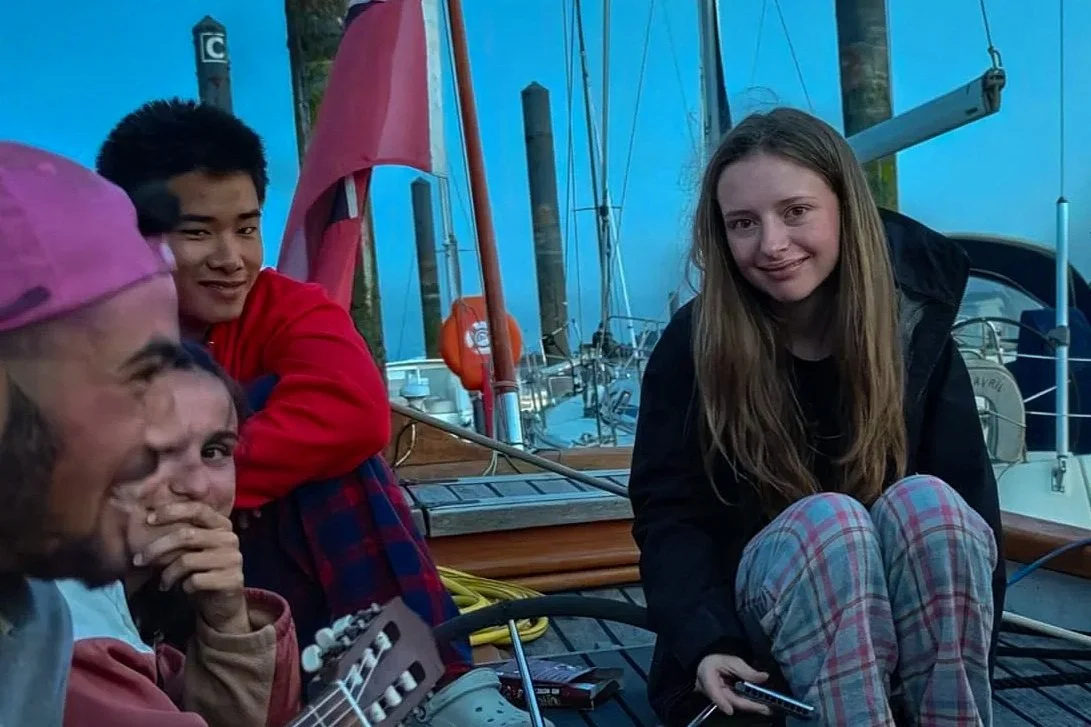
At QBE Sailing, our expeditions are not language courses, per se. Instruction is in English as is the sailing lexicon we teach, so some competence in the language is required. It turns out, many of our crew members are native English speakers. That said, we’re not a language school for those who aren’t. That’s not our thing. But… it’s interesting to see what happens on our expeditions. Anglophone teens share their idiomatic English with their non-native-speaking crewmates, including the nuances that sharpen listening comprehension and expression. French-speaking participants, in turn, become cultural ambassadors ashore, guiding their new friends through seaside cafés and harbor towns with essential conversational French. Learning is happening constantly, even though it’s unstructured and more practical. Importantly, there’s no intimidation factor to overcome on our expeditions, as is often the case in language classes. (No pop quizzes!) That helps make vocabulary acquisition fun for those who want to make the effort.
And the impact extends far beyond acquiring a more idiomatic lexicon.
When teenagers successfully navigate moments in another language—ordering food, asking directions, sharing a joke—they experience a shift in identity. They begin to see themselves as capable participants in a larger world. Daily exposure to international peers fosters a sense of cosmopolitan confidence: the subtle assurance that they can adapt, communicate, and function across cultures.
Why this matters for language learners:
Students who have meaningful international experiences are often more motivated to pursue language study seriously when they return home. Language is no longer an abstract academic requirement; it becomes a tool for connection, travel, and opportunity. The same is frequently true of the liberal arts more broadly. History, literature, culture, and global studies become tangible rather than theoretical.
Universities consistently value applicants who demonstrate cross-cultural competence, global awareness, and intellectual curiosity. But beyond admissions, these experiences cultivate something deeper: openness, empathy, and intellectual seriousness.
So while we don’t pretend to be an English- or French-language course, we repeatedly see our teens listen more attentively, speak more confidently, and approach learning with renewed purpose, largely because they have glimpsed a world full of unexpected wonder and want to start navigating it.