
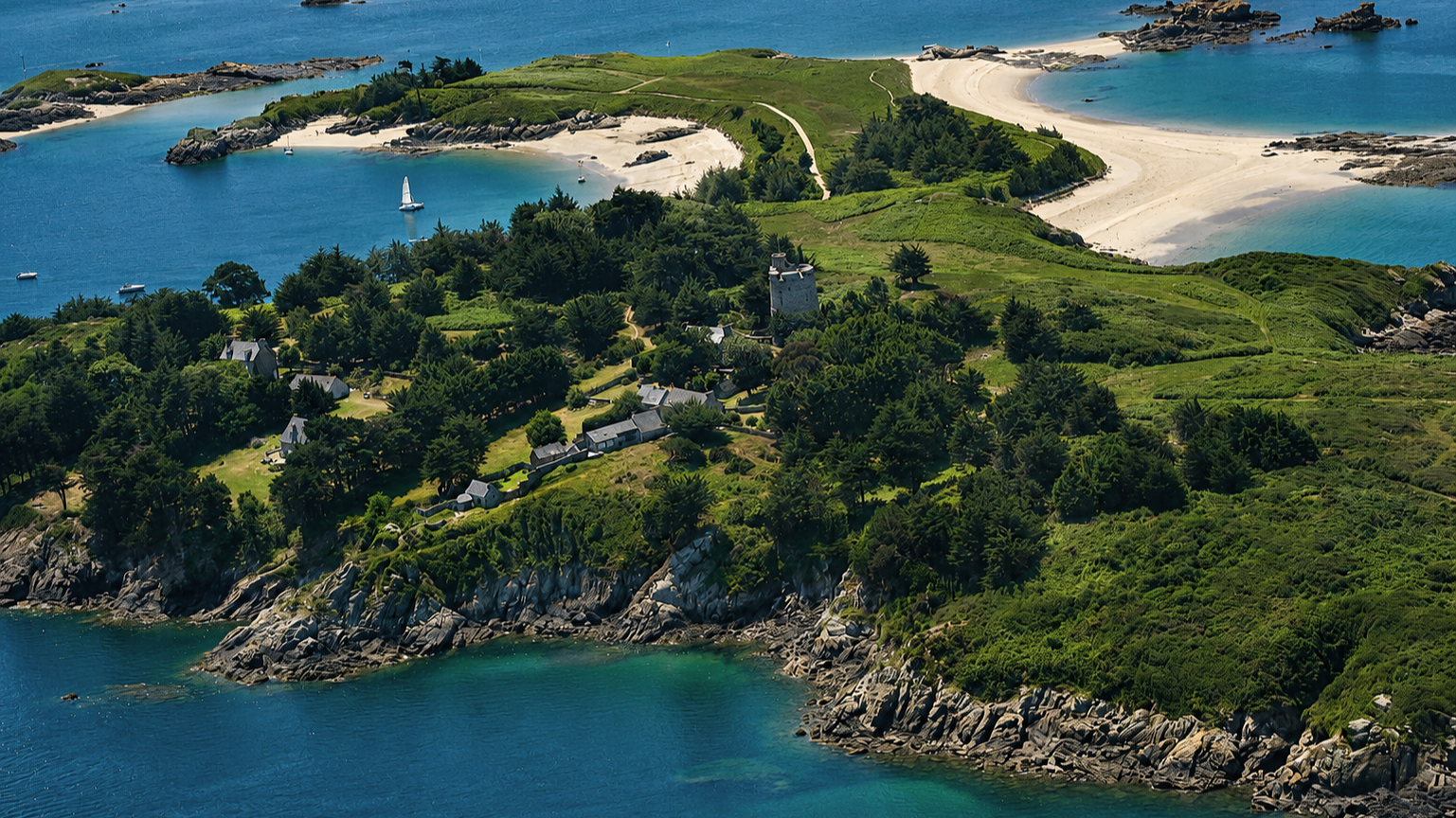
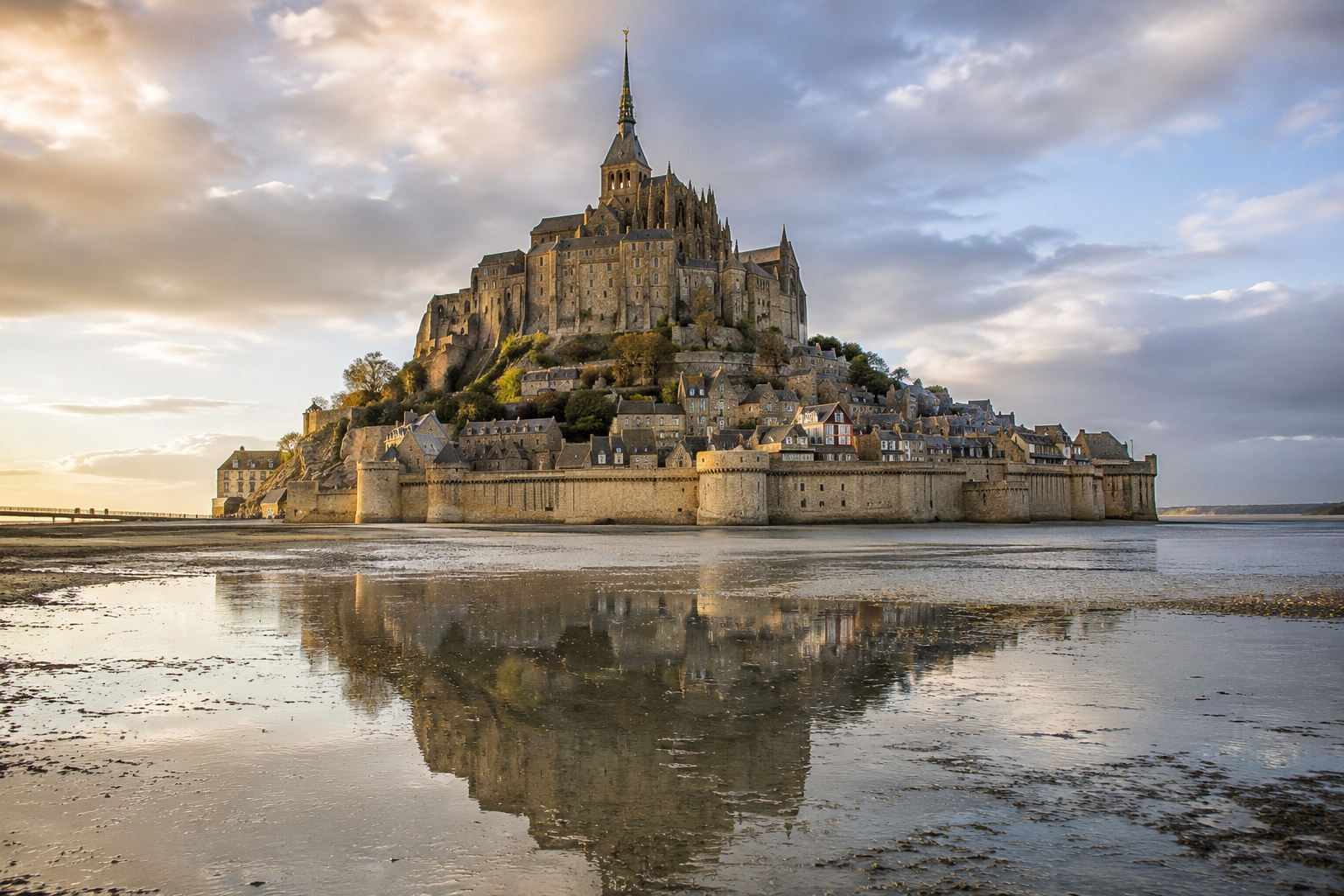
Mont Saint-Michel, a UNESCO World Heritage site. It attracts over three million visitors a year, the most visited attraction in France outside of Paris.
What Normandy and Brittany's rival claims reveal about two very different Frances—and one tidal island situated in the middle.
At first glance, the dispute seems almost comical. Ask a Norman where Mont Saint-Michel belongs, and you will receive a confident answer: Normandy, of course. Ask a Breton the same question, and you may get a lecture, a history lesson, a tidal-map demonstration, and perhaps a look suggesting that justice itself has been denied.
For centuries, both regions have claimed France's most magical island abbey. Officially, the answer today is simple: Mont Saint-Michel sits within the département of Manche—Normandy. Emotionally, however, the matter is far from settled.
And perhaps that’s fitting, because Mont Saint-Michel has always belonged to the borderlands—geographically, culturally, spiritually.
"Le Couesnon, dans sa folie, mit le Mont en Normandie."
— Traditional Breton saying
The joke refers to the shifting course of the Couesnon River, whose wandering channels historically marked the frontier between Brittany and Normandy. Since, over the centuries, the river often changed course, so too did the border. But behind the wink lies something deeper: two profoundly different regional identities competing for stewardship of the same symbol.
Two Frances
Normandy evokes
Dukes who conquered England
Rich agricultural plains
Military fortresses
Grand abbeys
Anglo-Norman order
Brittany evokes
Celtic legends & myth
Dangerous, shifting tides
Granite fishing villages
Great Christian missionaries arriving by sea
Proud “marginality”
Normandy's monuments often feel authoritative. Brittany's feel mystical. Mont Saint-Michel somehow embodies both.
Approaching the abbey across tidal flats, one senses immediately that it’s not merely architecture. It’a performative symbolism. Pilgrimage. Psychological landscape. A place built to dramatize the thin line between danger and salvation.
For medieval pilgrims, access to MS-M was challenging. The tides surrounding the mount were notoriously treacherous—capable of rising over a meter per minute in places, faster than a person can run. Sandbanks shifted. Fog rolled in. Travelers disappeared. To paraphrase Dante: “Use extreme caution, all ye who enter here.”
That atmosphere still lingers today. Inside, visitors encounter not only a soaring Gothic space, but curioua medieval carvings: demons, dragons, souls emerging from Hell, saints battling chaos. The imagery feels less like polished Renaissance classicism and more like something imagined beside stormy seas.
The Archangel at the Edge of the World
What the regional debate often obscures is the deeper spiritual logic that made Mont Saint-Michel contested in the first place. The mount is one of three sacred sites in Western Europe dedicated to the Archangel Michael, the others being Monte Sant'Angelo in southern Italy and St Michael's Mount off the coast of Cornwall. Medieval geographers believed these three points formed a straight "apparition line" across Europe, a celestial axis where the divine pressed closest to the earthly.
This was not an incidental location. It was a chosen edge. Michael, the warrior archangel and psychopomp who escorts souls between worlds, was specifically venerated at liminal thresholds: cliffs, promontories, islands ringed by murderous tides. The mount was not built here despite its danger. It was built here because of it. (Or, if you believe the legend, because the archangel himself told the bishop of Avranches to build a church on the site and punched a hole in his skull when he dawdled.)
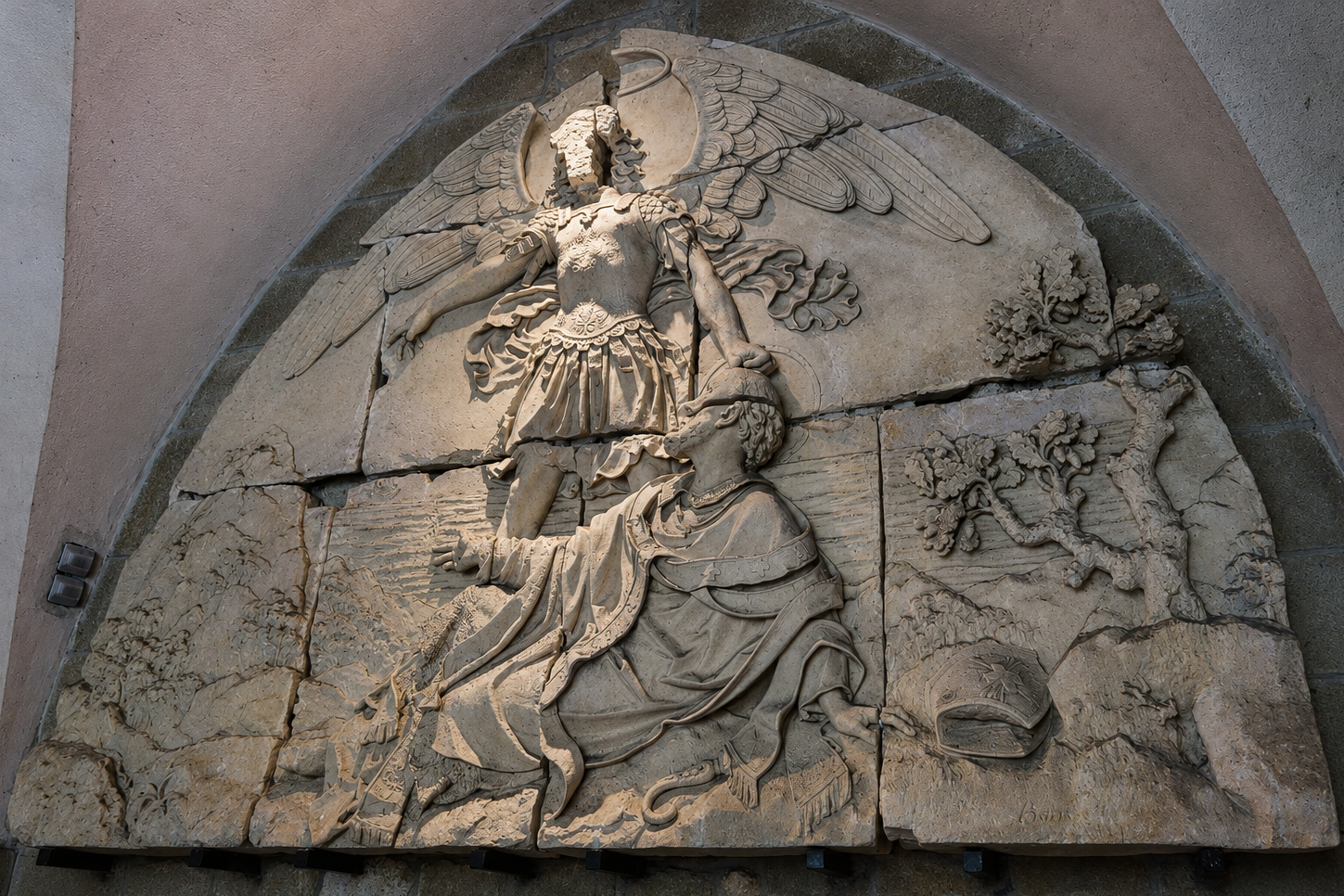
Bas-relief of St. Michael and Aubert, the bishop of Avranches, in the abbey church at Mont Saint-Michel. It was executed by Auguste Barré around 1860.
That explains, better than any river's course, why both Normandy and Brittany feel such ferocious ownership. To possess Mont Saint-Michel was never merely to control a border garrison. It was to hold a gate between the natural and supranatural worlds.
The Border in History
1007
Duke Richard II of Normandy installed Benedictine monks at the mount, establishing its Norman institutional character.
1204
Philip II of France seized Normandy from England. Breton allies partially sacked and burned the mount—then help rebuild it, funding the famous Gothic "Merveille" structure.
1790
The French Revolution redrew France into départements. The mount was placed firmly in Manche. The cultural wound deepened.
1874
Classified as a historic monument. The state claimed stewardship above regional identity.
2014
A new hydraulic dam and footbridge replaced the old causeway. Tidal flow was partially restored—the mount was once again surrounded by sea at high tide. The Couesnon was given back some of its old power.
That 2014 engineering project deserves more attention than it usually receives. For over a century, a built-up causeway had been slowly silting the bay, turning what was once a true tidal island into something closer to a peninsula. The restoration of the tides was partly practical (preventing the mount from becoming landlocked) and partly symbolic: an acknowledgment that the island's meaning is inseparable from the water that surrounds and threatens it.
In restoring the tides, France quietly restored the thing that made the mount matter in the first place.
Why Bretons Feel It Most
Mont Saint-Michel resonates deeply with the Breton imagination because Brittany itself has long cultivated a kind of proud marginality—a sense of existing somewhat at odds with modernity, closer to extreme tides, weather, memory, and myth. Even the light seems different along the Breton coast. Painters took note of this long ago. Writers did, too.
There is also a linguistic dimension. Breton, a Celtic language related to Welsh and Cornish, survived centuries of Parisian suppression and is now experiencing a modest revival. For Breton nationalists and cultural romantics alike, the loss of the mount to Normandy is inseparable from a longer story of absorption and erasure—the gradual cultural homogenization encouraged (and sometimes forced) by the centralizing French state.
The Couesnon wisecrack isn’t really a joke about a river. It’s a statement about power.
The Paradox of Ambiguity
The great paradox is that Mont Saint-Michel may owe its enduring power precisely to its ambiguity. It belongs fully neither to Normandy nor Brittany. It belongs to neither land nor sea, neither France nor the older Europe that France absorbed. It is a threshold place, and “debatable lands” derive a certain authority by resisting efforts to be fully claimed.
The medieval pilgrims understood this instinctively. You didn’t journey to Mont Saint-Michel for certainty. You went there because “certainty” had failed you somewhere else, and you wanted to stand at the edge of something vast and be reminded that reality was larger and more mysterious than it appeared at home.
Perhaps that is why the argument persists. And perhaps both regions are correct.
Normandy may administratively include Mont Saint-Michel. But Brittany still haunts it. And the indifferent tides continue to have a say in who may approach and who must wait.
The Couesnon, in its madness, placed the Mount in Normandy.
The argument, in its wisdom, keeps it somewhere between.