
The term is twenty years old. The problem has only gotten worse. And one of the most overlooked remedies happens to be… sailing.
In 2005, a journalist named Richard Louv published a book with an unusually blunt title: Last Child in the Woods: Saving Our Children From Nature-Deficit Disorder.
The term he coined was not, and was never intended to be, a clinical diagnosis. Louv himself has repeatedly emphasized that “nature-deficit disorder” was meant to describe the human costs of alienation from the natural world—not a medical condition, but a way of naming a problem many people sensed was growing yet lacked the lexicon to discuss.
Twenty years later, the phrase has endured. The problem has deepened. The book has been translated into more than twenty languages and helped launch an international movement to reconnect children, families, and communities with nature.
So when people speak of “NDD,” they are talking about a generational phenomenon.
What Louv Actually Argued
Louv’s central claim was straightforward: modern children were becoming increasingly separated from nature, and direct outdoor experiences are essential to healthy development.
Drawing on a growing body of research, he argued that diminished exposure to natural environments contributes to behavioral and emotional difficulties in children, while regular contact with nature can be genuinely restorative for both children and adults coping with stress, depression, obesity, trauma, and attention challenges.
The causes he identified in 2005 sound remarkably familiar today: growing dependence on electronic media, the loss of green spaces to development, exaggerated fears of natural and human dangers, and liability concerns that have steadily restricted access to open land.
The result, he argued, was a “denatured childhood”—a phrase that has become only more accurate with time.
One of the book’s most memorable anecdotes has been quoted countless times. Asked about his favorite place to play, a fourth-grader replied:
"I like to play indoors better, ‘cause that's where all the electrical outlets are."
That was 2005. That child would now be in his thirties. One wonders what he tells his own children.
The Research Hasn't Gotten Kinder
What makes nature-deficit disorder more than a clever turn of phrase is the growing body of evidence behind it.
Researchers Frances Kuo, Andrea Faber Taylor, and William Sullivan at the University of Illinois found that greener settings were associated with measurable relief from attention difficulties in children. Their findings echoed Louv’s own observation that the woods had functioned almost like medicine when he was young—calming and focusing him while still engaging his curiosity and imagination.
Since then, the research base has only expanded.
While scholars continue to debate mechanisms and magnitudes, the broad direction of the evidence is strikingly consistent: meaningful time spent outdoors improves attention, supports emotional well-being, enhances learning, and helps develop problem-solving, critical-thinking, and decision-making skills.
And yet, twenty years after the book that named the problem, the trend lines have not reversed.
If anything, they have accelerated.
The screens became smaller, more personal, and more persistent. Outdoor time became scarcer. The “wired generation” Louv worried about in 2005 now appears almost quaint compared to the generation growing up with smartphones in their pockets from childhood onward.
Why Nature Alone Isn’t Enough
This is where the conversation can stall.
The standard prescription for nature-deficit disorder—more parks, more outdoor play, more time spent simply being outside—is absolutely valid as far as it goes.
But for adolescents, it may not go far enough.
A walk in the woods can be transformative for an eight-year-old. It does not necessarily meet the developmental needs of, say, a sixteen-year-old who requires not only nature, but challenge. Not only fresh air, but responsibility. Not only freedom, but consequence.
What many proposed solutions overlook is that adolescents need experiences that combine nature with meaningful responsibility and real-world demands.
Telling a teenager to spend more time outdoors is sound advice. But it’s not the same thing as providing an environment that requires growth.
Which brings us to sailing.
The Sea as Nature With Consequence
If nature-deficit disorder describes a generation’s estrangement from the natural world, a multi-week sailing expedition may be one of the most complete antidotes available.
Not because it offers more nature than a forest or a mountain.
But because it offers a fundamentally different relationship with nature.
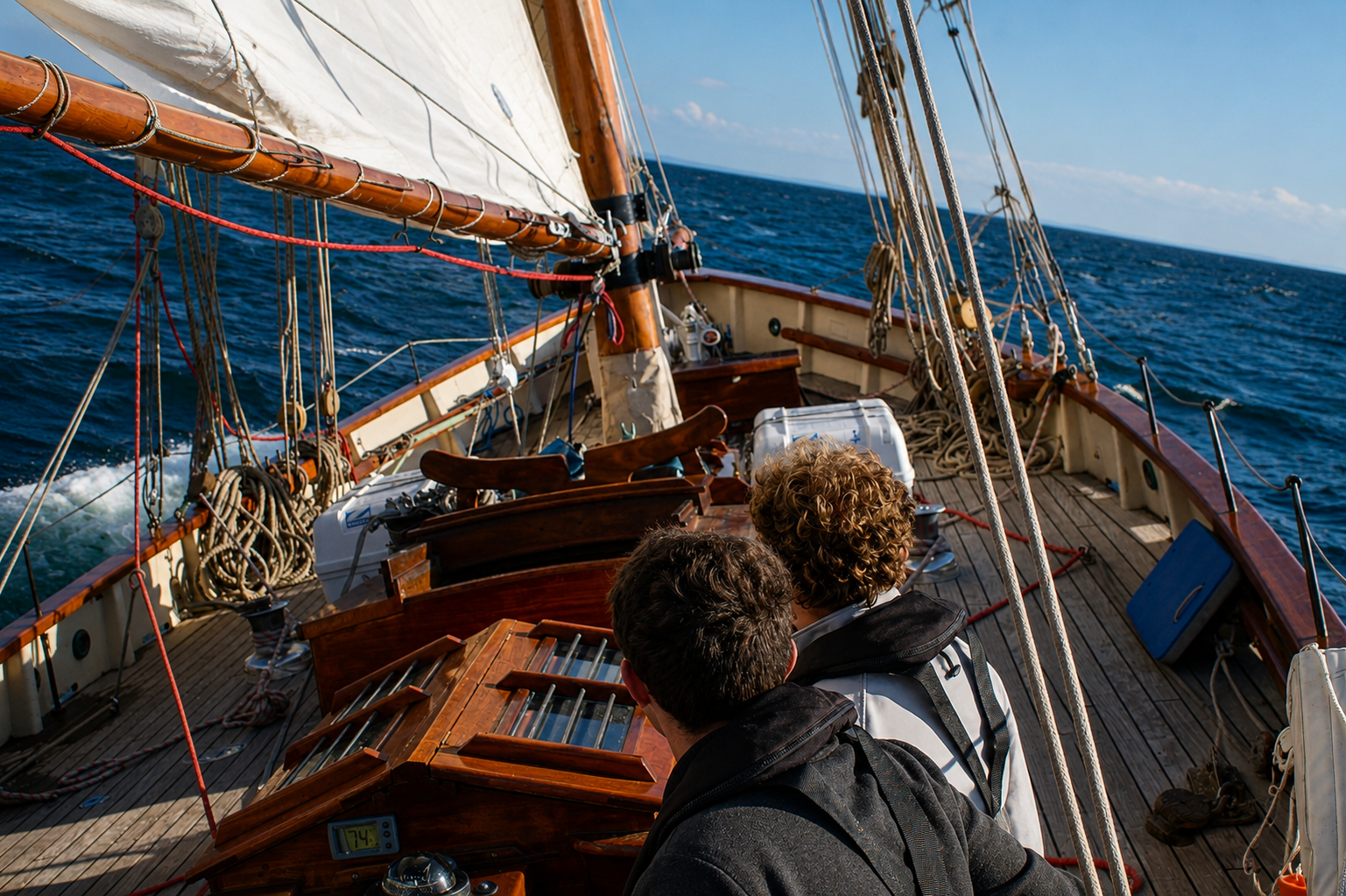
On a boat, nature is not scenery. It is the operating environment: The wind determines your speed. The tide determines your timing. The weather determines your options. Skill, judgment, and teamwork are not abstractions; they are daily necessities.
You can’t simply walk away when conditions become inconvenient. The environment demands attention, adaptability, and respect.
In that sense, sailing is almost the mirror image of the modern screen-addiction lifestyle.
Where nature deficit is characterized by distance, abstraction, and disconnection, a sailing expedition requires continuous, embodied engagement with the natural world.
You learn to read the sky because it matters.
You learn the rhythm of the tides because mistakes have consequences.
You stand watch beneath a genuinely dark night sky—something an astonishing number of teenagers have never experienced—not because it’s educational, but because the vessel requires someone awake and alert when it’s at sea, and tonight that someone is you.
Louv posited that even modest exposure to nature could improve attention and well-being.
It’s difficult not to wonder what three uninterrupted weeks of immersion in wind, tide, weather, and responsibility might accomplish for a teenager whose daily life is otherwise dominated by classrooms, screens, and carefully controlled environments.
A Generation That Has Never Been So Far From Outside
The statistics on screen time make the contrast uncomfortable.
For example, American teenagers reportedly now spend more than seven hours each day on screens for entertainment alone. Add schoolwork, transportation, and organized activities, and opportunities for meaningful outdoor experience become increasingly rare.
When Louv published Last Child in the Woods, the smartphone did not yet exist.
Screen time meant a television, a desktop computer, or perhaps a video game console in the corner of a living room.
Today’s reality would likely strike him not as surprising, but as confirmation of a trend he saw coming.
The good news is that the remedy has not changed. Direct, sustained, unmediated contact with the natural world remains as powerful as ever.
What has changed is the urgency—and perhaps the dosage required to make a meaningful difference.
A weekend hike is valuable. But it may not be enough to counterbalance thousands of hours spent indoors.
A multi-week sailing expedition, lived at the mercy of wind, tide, weather, and responsibility, just might.
The Cure Doesn't Have to Be Complicated
Richard Louv never prescribed sailing specifically.
His focus was broader: parks, forests, rivers, and the ordinary nature available to most families if adults are willing to make room for it.
That remains exactly the right starting point.
But adolescence presents a different challenge. At some point, young people need more than contact with nature.
They need responsibility. They need consequence. They need an environment that makes demands on them.
The sea offers all three.
It offers nature with stakes. Nature that requires participation rather than observation. Nature that does not care about notifications, algorithms, or battery life.
Twenty years after Louv named the problem, the diagnosis feels more relevant than ever.
And perhaps that is why sailing remains so powerful.
A boat isn’t simply a way to get young people outside. It’s a way of restoring them to the reality of the natural world they live in.