

The history you didn't know you were tasting
There is a reason Breton butter tastes the way it does. It is not the cows, though the cows do matter. It is not the grass, though the grass, fed by the Atlantic rain and the mild coastal climate, produces milk of unusual richness. It is not even the craft of the butter maker, though the craft matters enormously.
It all goes back to an excise tax exemption negotiated in 1532.
The Gabelle
France had a salt tax. It was called the gabelle, and it was one of the most hated excises of the French monarchy. The French crown had a monopoly on salt that dated to the 14th century, endured for four hundred years, and even contributed in part to the rage that eventually sparked the Revolution.
The gabelle was not seen merely as absurdly steep. It was capriciously applied. Different regions of France paid wildly different rates. Some paid a hefty amount, some paid a little, and the burden bore no relationship to wealth or ability to pay. It is important to know that salt was not a luxury. It was a necessity—for preservation, for cooking, for livestock, for survival through a northern European winter. Taxing it was taxing life itself, and the monarchy did so without apology for centuries.
The gabelle was finally abolished in 1790, one of the early achievements of the Revolution. By then it had already spawned a century of smugglers, enforcement agents, corruption, and resentment out of all proportion to its revenue.
Brittany’s Exemption
When the Duchy of Brittany was incorporated into France in 1532, through the marriage of Anne de Bretagne to the French crown, there followed an Edict of Union. Brittany negotiated its terms skillfully. The Bretons were not simply absorbed. They bargained. And among the concessions they extracted was an exemption from the gabelle.
Salt, in Brittany, was effectively free to use in whatever quantities a cook, a farmer, or a butter maker desired.
This may sound like a minor administrative detail. It was not. It changed the taste of everything.
While the rest of France used salt in cooking with the careful frugality of people who were paying through the nose for it, Brittany salted liberally, generously, without calculation. Butter—the product of those Atlantic-grazed cows, churned in farmhouse dairies along the coast—received the same treatment. Salt went in. And a lot of it. Because… it could.
The habit became the norm. The norm became the tradition. The tradition became the identity. And the identity became, over five centuries, the thing that makes a Breton meal taste like a Breton meal.
The Marshes of Guérande
The salt itself deserves a moment.
The marais salants of Guérande—the salt marshes that stretch along the Atlantic coast just south of the Loire, on the border of what is today considered Brittany—are among the oldest and most extraordinary salt-producing areas in Europe. They have been worked since at least the ninth century. At their medieval peak, they supplied salt to much of northern Europe, traded by the merchants of Nantes and Saint-Malo on routes that reached as far as Scandinavia and the Baltic.
The method for harvesting salt there has not changed. Paludiers—salt workers—tend the shallow clay pans by hand, managing the flow of seawater through a system of channels and basins as it evaporates through the summer months. At the surface of the water, in conditions of sufficient sun and wind, a delicate crust of crystals forms: fleur de sel, the flower of salt, harvested by hand with a flat rake called a lousse before it sinks to the bottom.
Fleur de sel de Guérande is now sold in gourmet shops from Paris to Tokyo to New York. What was once the cheap, abundant, everyday salt of Brittany—so plentiful the duchy could afford to exempt itself from a national tax on it—has become something people pay considerable sums to sprinkle on a finished dish.
The irony is not lost on anyone who knows the history.
What This Has to Do with Breton Butter
When Jean-Yves Bordier makes his beurre demi-sel in Saint-Malo (see our June 16 blog post)—the butter that sits in a great golden mound behind the counter at 9, rue de l'Orme and gets cut and wrapped in parchment while you watch—he uses Guérande salt. Fleur de sel, specifically, in quantities that would have been unthinkable to a butter maker in Normandy or the Île-de-France under the Ancien Régime.
The crystals do not fully dissolve into the butter. That’s the point. When you eat it on a warm baguette or croissant, you get occasional small bursts of salinity, a textural counterpoint to the richness of the fat. It is not seasoning in the background. It is salt as an ingredient, present and intentional, doing something that unsalted butter simply cannot do.
This is what five centuries of exemption from the gabelle tastes like.
A Duchy That Played by Its Own Rules
There is something characteristically Breton about the whole story. The region has always maintained a particular relationship with the French state: cooperative in broad terms, stubbornly autonomous in specifics. The Breton language, the Breton flag, the Breton insistence on their own saints, festivals, and calendar: all of it reflects an ésprit de région of a Celtic people who joined France on their own terms and have spent the subsequent five centuries reminding Paris of that fact.
The salted butter is, in its way, the most delicious expression of that independent spirit. While the rest of France developed a cuisine in which butter was used sparingly, unsalted, delicate—the neutral fat of classical French cooking—Brittany went its own way. Bold. Salty. Generous. Unashamed.
To this day, asking for beurre doux (unsalted butter) in a traditional Breton restaurant will get you a look. Not hostile. Simply puzzled: “What’s the matter with you?”
The Paludiers Today
The salt marshes of Guérande are a site classé—a protected landscape—and the paludiers who work them are among the last practitioners of an agricultural tradition that dates back over a thousand years. There are approximately 300 active paludiers working the Guérande marshes today, producing around 10,000 metric tons (tonnes) of sea salt and 200 tonnes of fleur de sel annually.
It is hard, seasonal, weather-dependent work. A cold summer produces little fleur de sel. A hot, windy one produces more. The paludiers cannot control the outcome, only the conditions—managing the water levels, maintaining the clay basins, watching the sky. It is, in its way, not so different from sailing.
The best way to understand what they do is to visit the marshes—the landscape is otherworldly, a grid of shallow pans stretching to the horizon, pink and grey and silver depending on the light and the season. Several paludiers offer guided tours in summer. If your itinerary allows for a detour south of the Loire, it’s worth the drive.
What to Buy and What to Do with It
If you are in Brittany and wish to bring the story home in edible form, the options are straightforward.
Fleur de sel de Guérande—buy it loose, in a small jar or a linen bag, from a paludier directly or from any serious food shop in the region. Use it only as a finishing salt—on a soft-boiled egg, on a piece of dark chocolate, on a ripe tomato with olive oil. Heat destroys the texture that makes it worth buying.
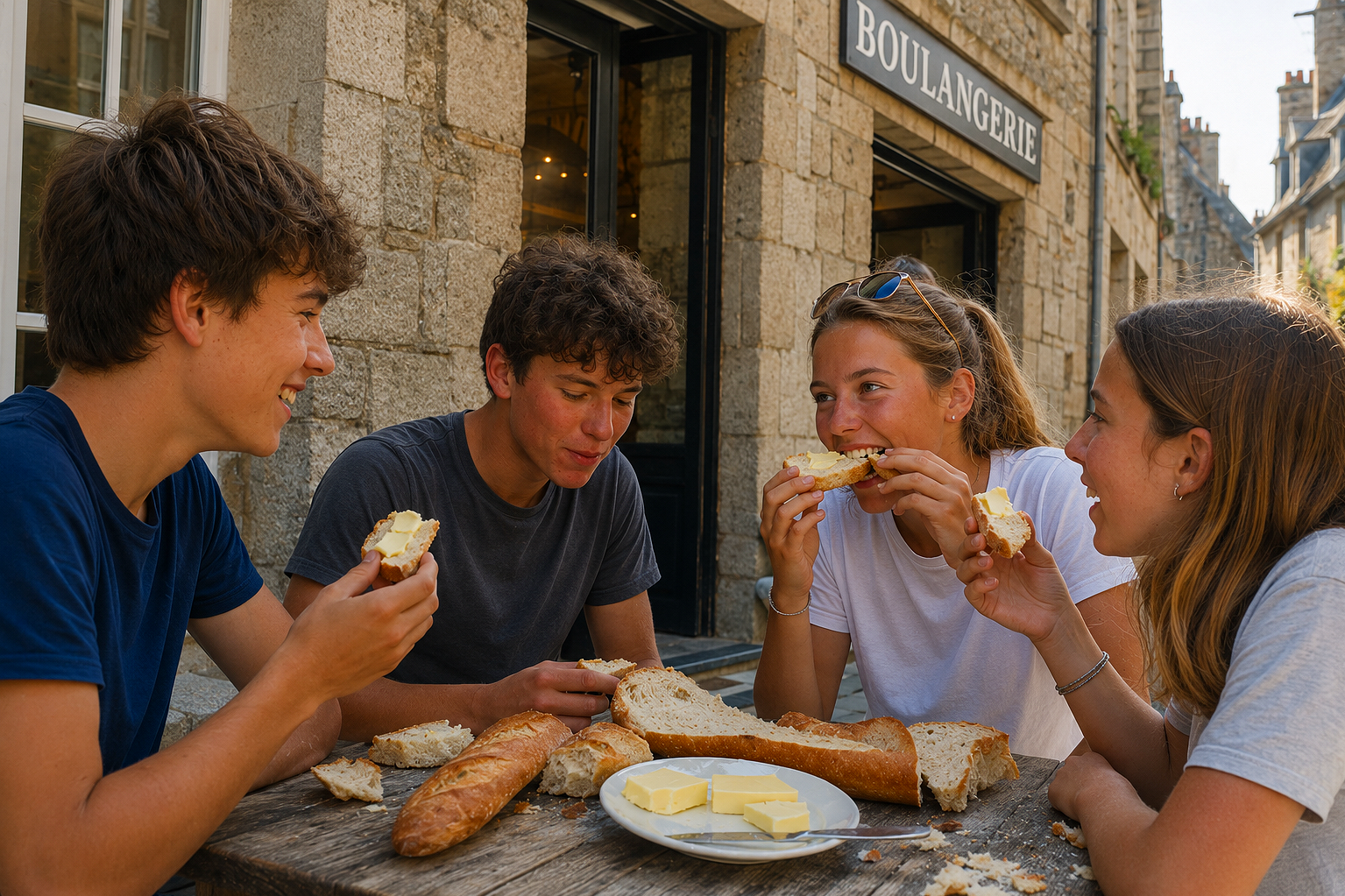
Beurre demi-sel Bordier — available at the Maison du Beurre in Saint-Malo (see our post below) and, if you are very lucky or very well-connected, at a handful of fromageries in Paris and specialty shops in New York and elsewhere. Eat it as the Bretons do: on good bread, without ceremony, in quantities that would have been impossible anywhere else in France before 1790.
And if someone asks why Breton butter tastes different from every other butter in the world, you now have an answer that covers five centuries, one abolished excise, and a duchy that cut a good deal when it sat down to negotiate.