
The premium enrichment market is booming. Here's what the data say, and what it means for the families choosing to invest.
Something is shifting in how parents think about summer.
Not long ago, the calculus was simple: find something safe, keep the kids busy, survive until September... or mid-August. A decent sports camp, maybe a language program abroad, perhaps a few weeks with a tutor. Summer was a gap to fill, not an opportunity to seize.
That's changing. And changing fast.
The global summer camp market, valued at approximately $9.4 billion in 2025, is projected to reach $13.5 billion by 2032. That's not growth driven by more children or longer summers. It's driven by a fundamental shift in what parents believe a summer can—and should—do for a youngster.
The word researchers keep using is “premiumisation.” Parents, particularly in North America and Europe, increasingly are willing to pay significant premiums for experiences they believe will genuinely make a difference. Not just entertain. Not just supervise. Actually matter—in ways that show up years later, in university applications, in careers, in confidence and character.
The question is: what experiences actually deliver on that promise? And how do you tell the difference?
The Screen Problem That’s Proving Hard To Solve
Start with the context, because it’s stark.
The average teenager now spends somewhere between seven and nine hours a day in front of a screen, and that figure doesn't include screen time for schoolwork. Social media, gaming, streaming, scrolling: the default state of adolescence in 2025 is essentially passive, essentially solitary, and essentially consequence-free.
Parents know this. They worry about it. And increasingly, they're making financial decisions in response to it.
The “digital detox” movement—once a fringe concern of anxious early adopters—has become a mainstream driver of purchasing decisions in the enrichment market. Families aren’t just looking for something fun to do with summer. They're looking for a genuine counterweight to the rest of the year.
What does a genuine counterweight look like? Well, not a week without phones at some woodland camp. Something longer, more immersive, more genuinely demanding. Something where the absence of a screen, or the serious curtailment of screen time, isn't a rule to be enforced, but an irrelevance—because there's simply little or no bandwidth for it when you're handling real responsibility in a real environment.
What the Research Actually Says About Learning That Sticks
Here's where it gets interesting, and where a lot of enrichment programs quietly fall short.
The psychologist Hermann Ebbinghaus identified what he called the “forgetting curve” in the late 19th century, and subsequent research has confirmed it repeatedly: without reinforcement, we forget approximately 50% of new information within a day, and up to 90% within a week. Classroom learning, workshop learning, structured instruction in comfortable environments; it fades, and it fades fast.
Experiential learning pioneer David Kolb demonstrated that an alternative strategy can mitigate that problem. Learning that happens through direct experience—through doing, reflecting, and doing again—produces retention rates dramatically higher than passive instruction. The thesis is straightforward: when the stakes are real, when failure has actual consequences, when the body and the emotions are engaged alongside the mind, the brain encodes the experience differently. It goes deeper, and it stays longer.
This isn’t abstract theory. It’s the reason military training works the way it does. It’s the reason surgeons learn by operating, not by watching. And it’s the reason that a summer spent doing something genuinely challenging, something with real risk and real reward, produces changes in young people that a classroom course simply cannot replicate.
The enrichment programs now attracting serious parental investment are, almost uniformly, the ones that lever this. The question isn’t how much instruction can we deliver. It's how real can we create an impactful experience.
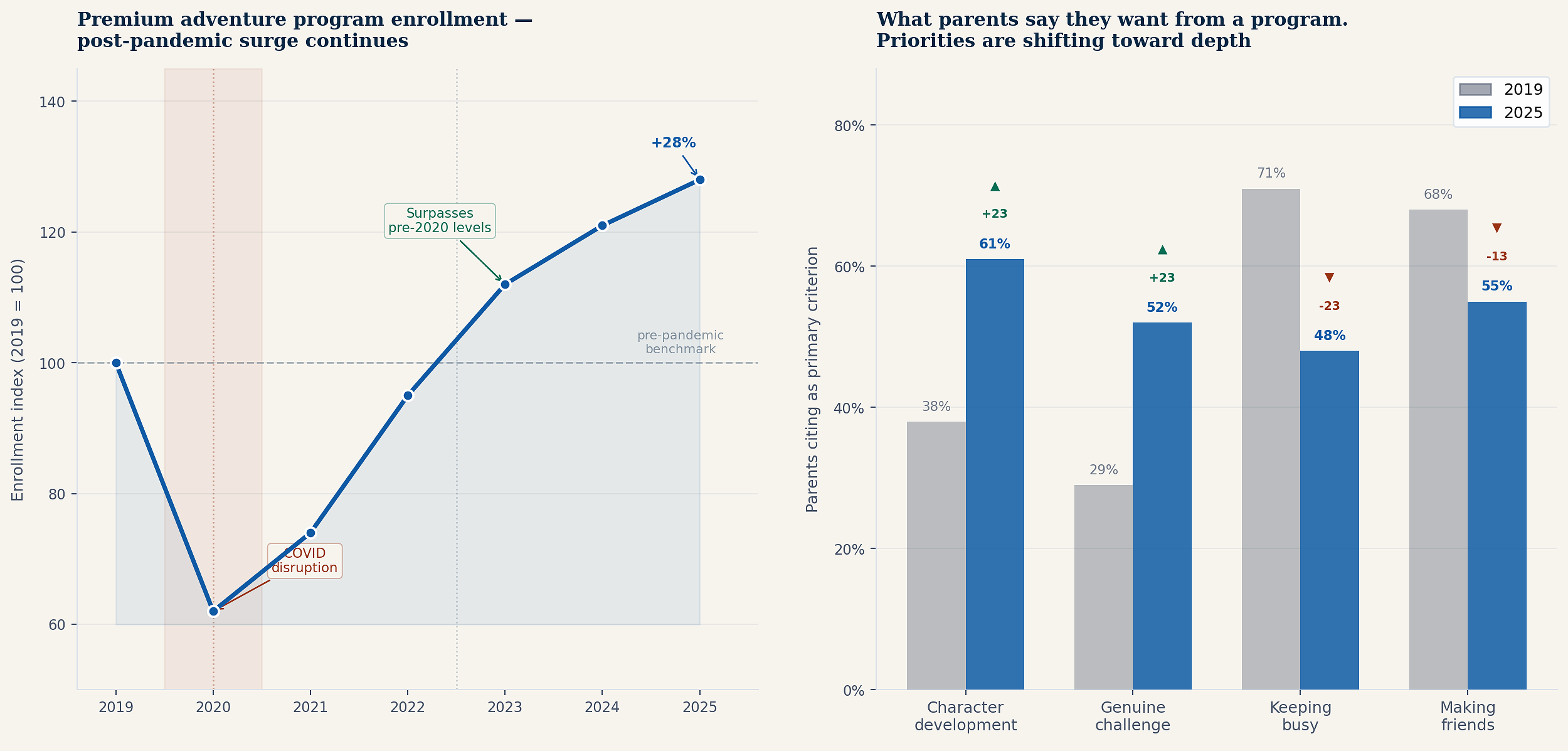
Sources: American Camp Association survey data; industry enrollment estimates. Figures are illustrative of reported trends.
The Data Behind the Boom
The numbers are worth noting, because they reveal an instructive trend.
The premium and adventure segment is where market growth is most concentrated. Post-pandemic enrollment levels at high-quality outdoor and expedition programs surpassed pre-2020 benchmarks in 2023 and have kept climbing. At the top end of the market—programs charging between $4,000 and $8,000 per participant for two to three week residential experiences—many are reporting waitlists rather than vacancies.
This isn’t surprising when you look at what’s driving parental decision-making. A 2025 survey by the American Camp Association found that parents prioritizing "character development" and "genuine challenge" as primary criteria for program selection had grown significantly as a proportion of the market. "Keeping busy" and "making friends," historically the top two drivers, have fallen relative to deeper developmental criteria.
International diversity is another emergent priority. Programs that draw participants from multiple countries—giving young people genuine cross-cultural experience rather than the simulated version available in a classroom—command premium positioning and, anecdotally, stronger loyalty. Families who find a program that delivers on this tend to return. Not just the following year. But year after year.
What Parents Are Actually Buying
Scratch the surface of what’s driving this market, and you find a cluster of parental anxieties that no amount of purely academic enrichment seems to address.
Resilience. The word comes up constantly in conversations about what parents want for their teenagers. Not confidence in the sense of feeling good about themselves, but actual resilience (or grit), the kind that comes from having faced something genuinely hard and come through it. This is difficult to achieve without real skin in the game. It requires real adversity, not simulated adversity. It requires a situation where giving up is not an option.
Independence. Counterintuitively, the most dedicated parents, the ones most involved in their children's education and development, are often the ones most aware that their involvement has limits. At some point, a young person needs to discover what they’re made of without a parent nearby to prop them up. The right program creates that space safely.
Genuine human connection. In an era of algorithmically mediated social life, many teenagers have extensive online networks and startlingly few deep friendships. Shared adversity—the kind that happens when a group of young people face something genuinely difficult together—creates bonds of a different order. Parents understand this intuitively, even if they can’t always articulate it.
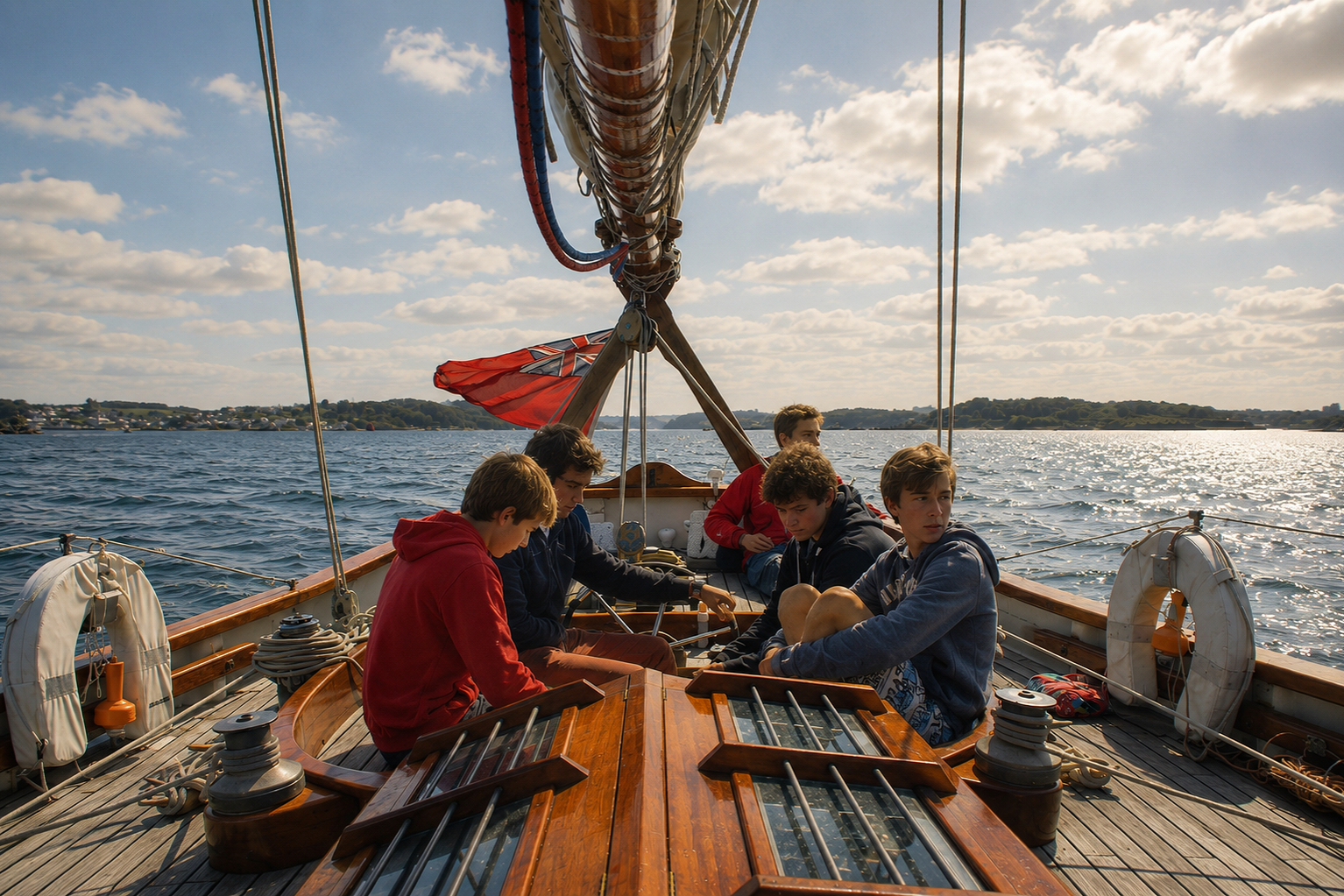
Something to talk about. This one is underrated. University admissions tutors and job interviewers report that they can spot a genuinely formative experience in an interview within minutes. The student who spent a summer, say, sailing the English Channel talks differently about challenge, failure, teamwork and self-knowledge than the student who did a structured internship or attended a prestigious academic program. The difference is not always easy to quantify, but it is consistently easy to notice.
The Gap the Market Hasn’t Filled
Here’s what the data don't quite capture, and what the most interesting programs in this space understand intuitively.
Most enrichment programs, even the good ones, are fundamentally comfortable. They are organised, they are supervised, they are structured, and they are safe in a way that slightly undermines their own developmental goals. The environment is controlled. The consequences of failure are managed. The team can leave at the end of the day.
The programs that produce the most dramatic and lasting change in young people share a different quality. They are genuinely inescapable. The team is the team because there is nowhere else to be. The challenge is real because the environment cannot be scripted. The responsibility is actual because other people’s wellbeing depends on it.
This is a harder experience to create, and a harder experience to sell. It requires parents who trust something they haven’t experienced themselves or had the chance to fully inspect. It requires young people willing to step into genuine uncertainty. And it requires a program prepared to hold that uncertainty rather than manage it away.
The families who find their way to these programs—and the young people who come back from them—tend to be unequivocal. Not just that it was terrific. But that it was extraordinary. The experience against which other experiences are measured. The summer they still talk about a decade later.
That’s what the market is really looking for. And that, more than any trend line or market valuation, is what makes this sort of experiential enrichment feel genuinely significant.