
New research raises a salient question: In our determination to keep children safe, are we depriving them of experiences essential to growing up?
There was a time when childhood involved a considerable amount of unsupervised adventure.
Kids climbed trees, explored woods, rode bicycles to school or the library, and occasionally came home with scraped knees. Parents worried, of course. But they also accepted that discovering the world involved uncertainty, and sometimes a little risk.
Today, we supervise children’s activities, monitor their whereabouts, organize their schedules, and work diligently to eliminate foreseeable dangers.
Much of this is unquestionably beneficial.
But have we gone too far?
What the research SUGGESTS
A major international research review published in October 2026 in the scientific journal PLOS ONE examined 74 studies of adventurous outdoor play among children ages 3–12 (admittedly younger than our cohort).
Led by researchers at the University of Exeter and the University of British Columbia, the review found associations between adventurous play and better physical and mental health, along with positive social and cognitive development.
The researchers also examined independent mobility—children’s freedom to explore without constant adult supervision—and found an association with greater physical activity.
Importantly, the findings demonstrate associations, not definitive cause and effect. Nor can research involving younger children automatically be extended to teenagers.
Nevertheless, the study raises a provocative question about the consequences of increasingly restricted childhoods.
Read the original research paper in PLOS ONE.
The difference between danger and risk
Danger and risk are not the same thing.
Danger is something we should seek to prevent. Risk, properly understood and managed, can be an important part of learning.
A child climbing a tree has to judge the strength of a branch and decide whether to climb higher. A teenager navigating a sailboat must learn to read the wind, anticipate changing conditions, and make consequential decisions.
Neither activity should take place without appropriate safeguards. But neither offers the same opportunities for growth if an adult makes every decision.
There is a difference between protecting young people from harm and protecting them from challenge.
And perhaps the most valuable learning occurs when they discover they're capable of something they previously thought was beyond them.
When responsibility becomes real
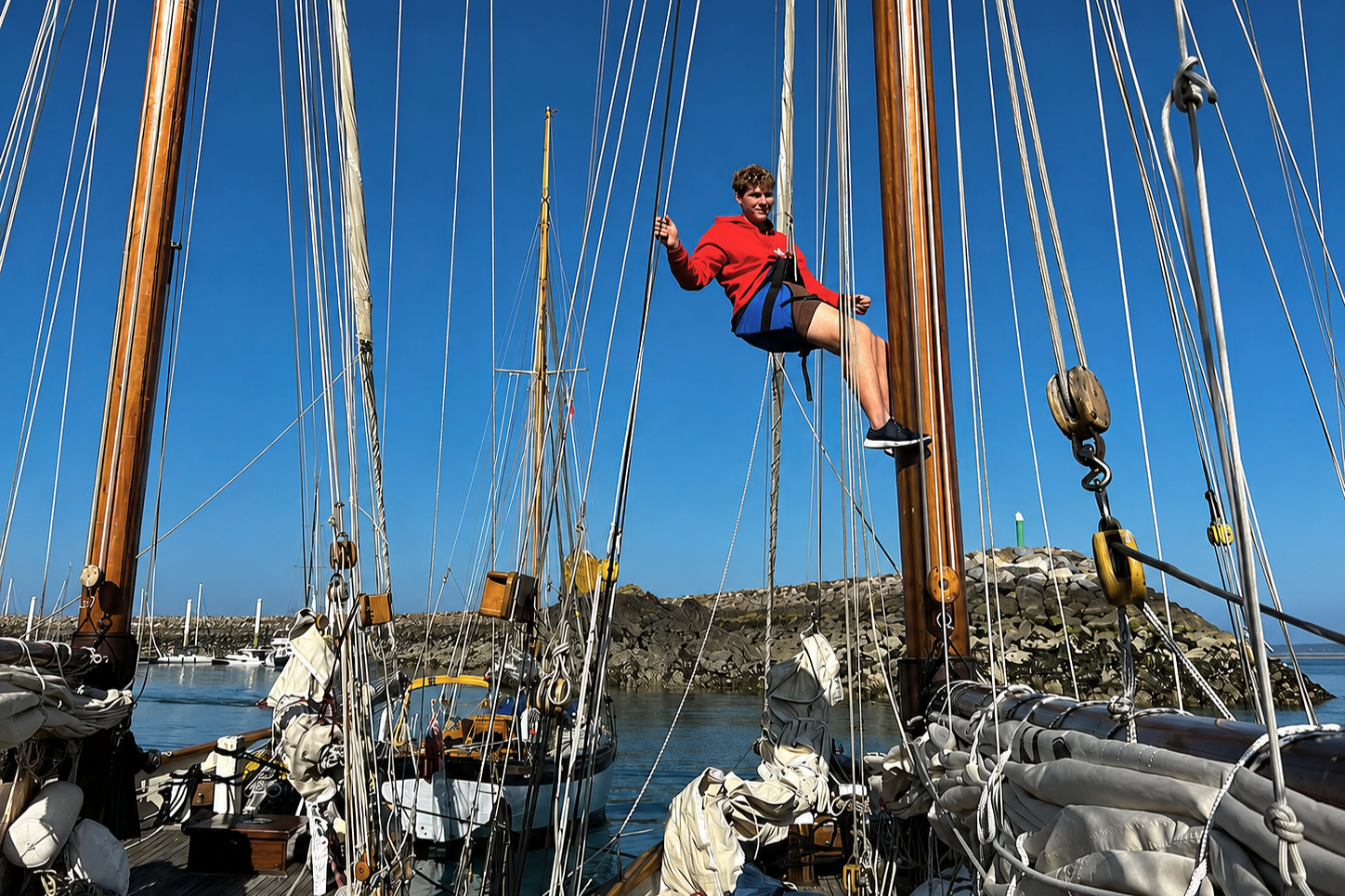
At The QBE European Leadership School, we see this every summer aboard our traditional cutters.
Our teenage crews don’t simply accompany adults on sailing excursions.
They learn to steer the vessels, navigate, calculate tides, prepare meals, and work together to manage life aboard.
Professional instructors remain responsible for safety. But within that framework, young people are encouraged to make decisions, take initiative, and contribute meaningfully to the expedition.
Sometimes the weather is glorious. Sometimes… not so much. Occasionally, a carefully considered plan has to be abandoned because the wind or tides have other ideas.
And that’s part of the experience.
The sea is wonderfully indifferent to anyone’s self-esteem. It responds to competence, preparation, cooperation, and sound judgment.
A teenager who successfully steers a 46-foot sailing cutter into harbor has accomplished something tangible.
The confidence that follows hasn’t come from a canned motivational speech.
It's been earned through experience.
What are we really protecting?
All parents wants their children to be safe.
But parents also want their youngsters to become confident, resourceful, independent adults—people who can make decisions, recover from setbacks, and confront unfamiliar situations.
How do young people acquire those capabilities if adults continually remove the opportunities to develop them?
At QBE, we have a saying:
We don't take our crew members sailing. They take us sailing.
It's a deliberately provocative way of expressing a serious educational principle: Young people will surprise you at how well they step up when the adults step back.
The Exeter research doesn't advocate exposing children to unnecessary hazards. It does suggest that independence, exploration, and manageable uncertainty deserve a place in our understanding of healthy development.
Perhaps the question isn't simply how we can make childhood safer.
Perhaps we should also ask how we can make growing up more meaningful.
Because the ultimate purpose of protecting children isn't to keep them children forever. It's to help them become capable adults.
The QBE European Leadership School offers small-group sailing and leadership expeditions for teenagers ages 14–18 along the coastlines of Brittany and the Channel Islands on classic yachts.