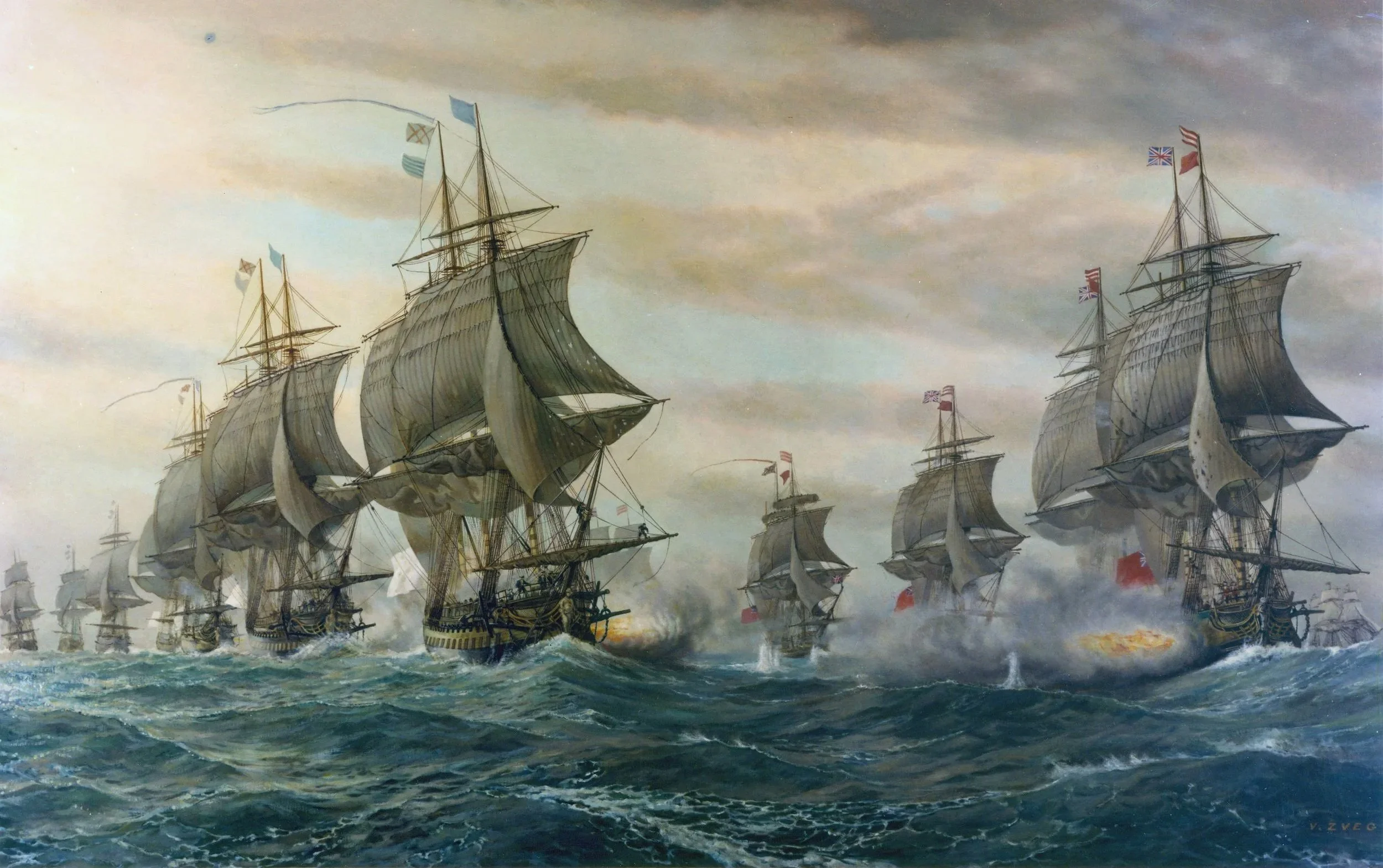
The Battle of the Chesapeake, the decisive naval engagement that sealed British general Charles Cornwallis’s fate at Yorktown. This 1969 oil-on-canvas painting titled “Battle of the Virginia Capes, 5 September 1781” by artist Vladimir Zveg was commissioned by the U.S. Navy. It portrays the French fleet under the Comte de Grasse engaging the Royal Navy at the mouth of the Chesapeake Bay. ©U.S. Navy Art Collection, Naval History and Heritage Command.
This Bastille Day (July 14), a story most Americans have never been told: the steep price LouisXVI paid for helping make the United States a reality.
Earlier this month, we wrote about the day Benjamin Franklin stepped off a fishing boat in the Breton harbor of Auray, in December 1776, and began the diplomatic mission that would change the course of history. This is the sequel to that story. It’s about what happened after. What it cost. And the extraordinary, almost cinematic chain of cause and effect that led from a small port in Brittany to the storming of the Bastille just thirteen years later.
Most Americans know, vaguely, that France helped them win the Revolution. What most Americans don’t know is how much France helped, how decisive that help actually was, or what it ultimately cost the French monarchy to provide it. The short answer to all three questions is: a lot.
The Scale of French Commitment
When France formally allied with the United States in February 1778—the treaties that Franklin had spent fourteen months negotiating from his base in Paris—it wasn’t issuing a letter of support. It was committing to a war.
Roughly 12,000 French soldiers served the American rebellion, along with some 22,000 naval personnel aboard 63 warships. The Comte de Rochambeau commanded an expeditionary force of 5,000 French troops that marched alongside Washington’s Continental Army. The Marquis de La Fayette—who had come to America at his own expense even before France formally entered the war, inspired by the ideals of the American cause—served as a major general in the Continental Army and would eventually command troops in the decisive siege of Yorktown.
Pierre Charles L’Enfant, who would later design the street plan of Washington D.C., joined the Revolutionary forces in 1777. France was not a sympathetic bystander. It was a co-belligerent.
And then there was the money. The French crown spent an estimated 1.3 billion livres on war costs, equivalent to double the French treasury’s annual revenue at the time. How much is that in today’s dollars or euros? Good luck finding an answer. (There were no dollars or euros in 1776.) Several sources peg it between US$10–13 billion today. And this was on top of debts already accumulated from the Seven Years’ War, which France had lost to Britain just fifteen years earlier. The financial cost of the war significantly worsened France’s fiscal stability, contributing to a more general economic crisis that would eventually help trigger the 1789 Revolution.
The Battle Most Americans Have Never Heard Of
Of all the French contributions to American independence, none was more decisive, or more overlooked in standard American history education, than what happened on September 5, 1781, in the waters off Cape Henry, Virginia.
By the summer of 1781, the Revolutionary War had ground to something close to a stalemate. The British held New York. Washington’s army was exhausted and undersupplied. The Revolution’s success was far from certain.
Then Admiral François-Joseph-Paul, Comte de Grasse, made a decision that changed everything.
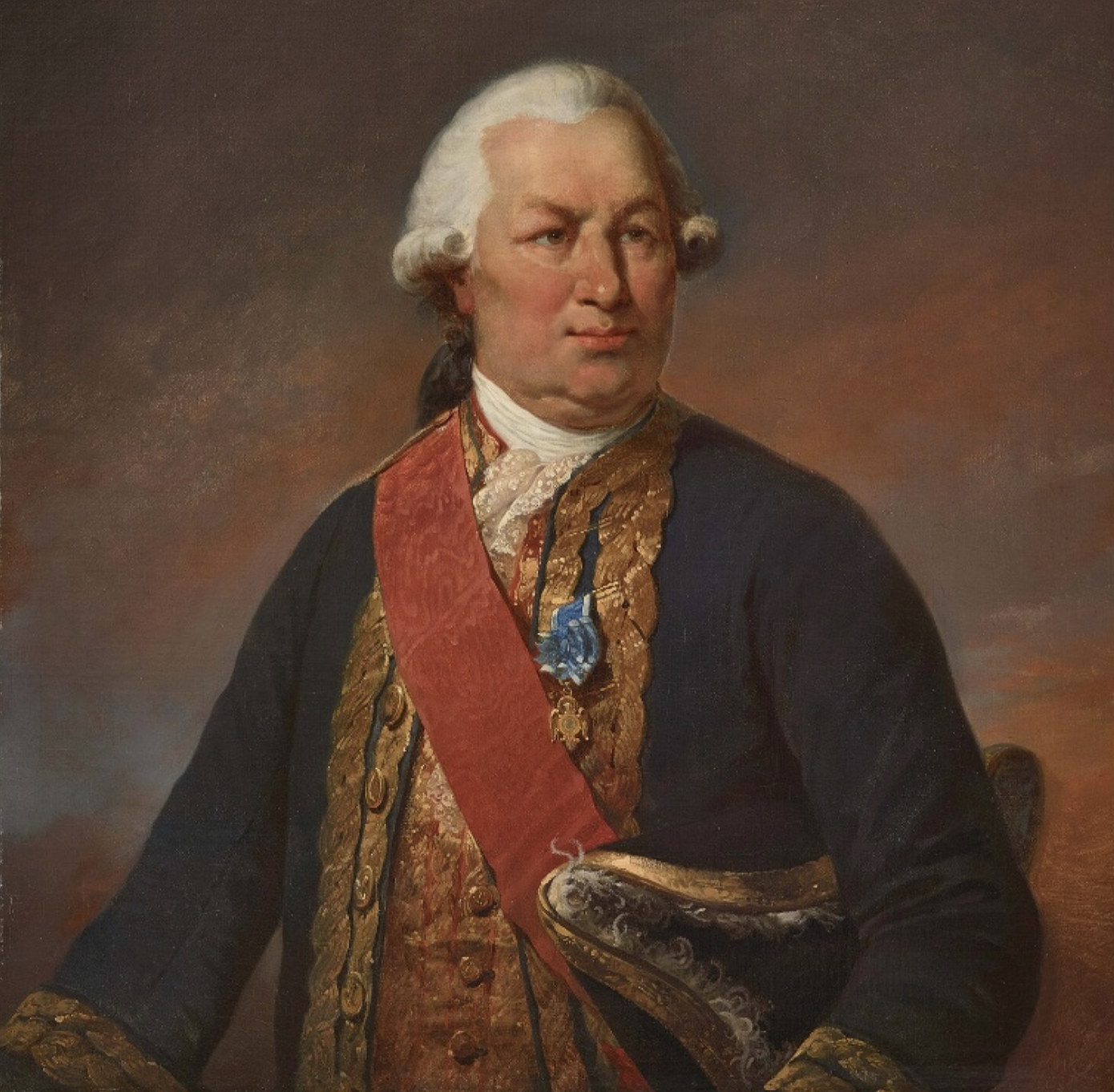
Admiral François-Joseph-Paul, Comte de Grasse
De Grasse commanded the French fleet in the West Indies. His orders were to stay put. Instead, in July 1781, he wrote to Rochambeau that he would bring his entire fleet—28 ships of the line—north to the Chesapeake Bay. By ignoring orders, he knew that failure, or even serious losses, would bring an inglorious end to his naval career. Still, he decided to wager everything—his reputation, personal assets, and honor—on achieving success in the northern Virginia theater.
In the end, that decision to take his fleet to the Chesapeake was surely the single most important event leading to American victory at Yorktown.
On September 5, the British fleet under Rear Admiral Thomas Graves arrived at the mouth of the Chesapeake to relieve Cornwallis. De Grasse, whose ships were at anchor and whose crews were partially ashore on various duties, made another audacious call: he ordered his captains to cut their anchor cables, leaving the anchors on the bay floor, in order to engage the British as quickly as possible.
The battle that followed was not the largest naval engagement of the era. Just one ship was scuttled. The casualties were modest. But the strategic consequences were enormous. Graves withdrew northward to New York to refit his damaged ships. He never returned. Without logistical support and reinforcements, the British Army was forced to surrender at Yorktown, which ultimately ended combat.
Washington himself understood what de Grasse had accomplished. He wrote to the admiral directly: "Whatever efforts are made by the land armies, the navy must have the casting vote in the present contest."
King George III wrote, well before learning of Cornwallis’s surrender, that “after the knowledge of the defeat of our fleet... I nearly think the empire ruined.”
On October 19, 1781, Lord Cornwallis surrendered to Washington. The British general was too ill to attend the ceremony himself—or perhaps too humiliated; historians disagree. But whatever the reason, he sent a deputy to hand over his sword. The British band reportedly played a tune called The World Turned Upside Down. When news of the British surrender reached London, Prime Minister Lord North exclaimed: “Oh God, it is all over! It is all over!”
The illness that incapacitated Cornwallis—and much of his army—deserves a paragraph of its own, because the story has an almost Greek tragic quality to it. The disease was not yellow fever, as is sometimes suggested, but malaria, carried by the Anopheles mosquitoes endemic to the tidal marshes and estuaries around Yorktown. Cornwallis had actually tried to escape it. His army had been devastated by malaria during the Carolina campaign of 1780. He wrote that his regiments were “so totally demolished by sickness [and] will not be fit for actual service for some months.” In the spring of 1781, he deliberately marched north specifically to get away from the disease, telling his superiors he needed to “preserve the troops from the fatal sickness which so nearly ruined the army last autumn.” He headed for the healthier Virginia highlands. But General Clinton in New York ordered him to establish a fortified port in the Tidewater: prime mosquito country. Cornwallis objected, questioning the logic of occupying a “sickly defensive post in this Bay.” Orders were orders (well, at least for British officers). He dug in at Yorktown in midsummer, and the mosquitoes found him again.
By the time of his surrender, Cornwallis had only 3,200 men fit for duty out of an army that had numbered 8,700 at the start of the siege—barely 37 percent. The commander of the Hessian mercenaries fighting alongside him reported two days before the capitulation that the British were "nearly all plagued with fever. The army melted away… among whom not a thousand men could be called healthy." Cornwallis himself, in his surrender dispatch, attributed his defeat not primarily to the enemy but to disease (and of course his inability to evacuate his men): “Our numbers had been diminished by the Enemy’s fire, but particularly by Sickness.” The Franco-American forces were spared largely by timing—malaria takes roughly a month from bite to symptoms, and they had arrived in the Tidewater only in September, two months after the British had begun absorbing the parasite. History’s invisible third army had chosen its side.
De Grasse’s fleet was visible from the shore as the British army filed out to stack their muskets. The Americans had won. But the French admiral who made it possible would not enjoy his triumph for long. Just six months later, at the Battle of the Saintes in the Caribbean, a British fleet under Admiral Rodney defeated the French and captured de Grasse himself. He spent time as a prisoner of war in England before being returned to France, where he faced a court martial for the loss of his flagship. He died in 1788—one year before the Revolution his country’s sacrifices had helped set in motion.
The Debt That Could Not Be Repaid
France had gone to war against Britain in support of the American colonists for reasons that were partly idealistic and largely strategic. Britain was France’s great rival, and weakening it by supporting the rebellion in its American colonies seemed like sound policy.
It was… in the short term. The Americans won. Britain was humbled. France’s prestige soared.
But the bill was enormous, and France couldn’t pay it.
France primarily used loans to fund the 1778 to 1783 Anglo-French War. Even after it ended, the monarchy continued to borrow heavily, and by 1788, half of state revenue went on servicing its debt.
Half. Of all the money France raised in taxes and other income, half went straight back out as interest payments on loans. There was almost nothing left for the actual running of the country.
Then the situation was made even worse by two factors that had nothing to do with the American war. The harvest of 1788 was catastrophic: a severe drought followed by a brutal winter destroyed crops across France, sending the price of bread, the staple food of the French poor, to levels that many families simply couldn’t afford. And France’s system of taxation was hardly equitable: the nobility and the clergy, who owned most of the country’s wealth, were largely exempt, leaving the burden on those least able to bear it.
The financial crisis and the measures taken by the king to address it forced Louis XVI into a corner from which there was no elegant exit. In December 1786, he convened an Assembly of Notables, an emergency gathering of the most powerful figures in the kingdom, to try to resolve the fiscal crisis. The Assembly failed to agree on reform. Louis then called the Estates General, the nearest thing France had to a parliament, which had not met since 1614.
It convened in May 1789. It did not go as the King had hoped. The Third Estate—the commons—refused to be outvoted by the two privileged cohorts, declared themselves a National Assembly, and began drafting a constitution. Louis locked them out of their meeting hall. Undeterred, they assembled on a nearby tennis court and took an oath not to disband until they had given France a new political order.
On July 14, 1789, a crowd stormed the Bastille fortress in Paris, partly to seize its gunpowder, partly as a symbolic assault on royal tyranny. The French Revolution had begun.
The Irony That History Rarely Stops to Appreciate
The French soldiers who had served in America under Rochambeau came home with more than campaign medals. They came home having seen a society without an aristocracy, without the rigid hierarchy of the Ancien Régime, without a system that taxed the poor and exempted the rich. Research has shown that the departments of France from which more of Rochambeau’s soldiers hailed experienced significantly more anti-feudal revolts between 1789 and 1793. The men who had fought for American liberty were, it turned out, inclined to want some for themselves.
La Fayette himself straddled both revolutions. He commanded Continental Army troops at Yorktown. Eight years later, he commanded the Paris National Guard when the Bastille fell, and he presented the key to that demolished fortress to George Washington as a symbol of the revolutionary kinship between the two nations. That key still hangs at Mount Vernon.
The ideals of the American Revolution—liberty, equality, the rights of man—had crossed the Atlantic in both directions. They arrived in France partly in the minds of soldiers who had watched them practiced, and partly in the pamphlets and ideas of Enlightenment philosophers who had been corresponding with Franklin, Jefferson, and their circle for years.
Thomas Jefferson, America’s Minister to France from 1784 to 1789, was in Paris as the Revolution began. He watched the Estates General convene in May. He was present as events accelerated through the summer. He left France for Virginia in September 1789, just weeks after the Bastille fell, carrying with him the conviction—which he held for the rest of his life—that the French Revolution was the inevitable daughter of the American one.
He was not wrong about the kinship. He was rather optimistic about how the daughter would turn out. The American Revolution produced a republic. The French Revolution produced, after years of terror, a republic too; but first it produced the guillotine, the September Massacres, the execution of Louis XVI, and eventually the reign of Napoleon.
Louis XVI was guillotined in January 1793. The king whose ministers had argued so fiercely about whether to support the American rebellion—whose treasury had been bled dry by the decision to do so—died as a victim of a revolutionary fever that his support for America had helped unleash.
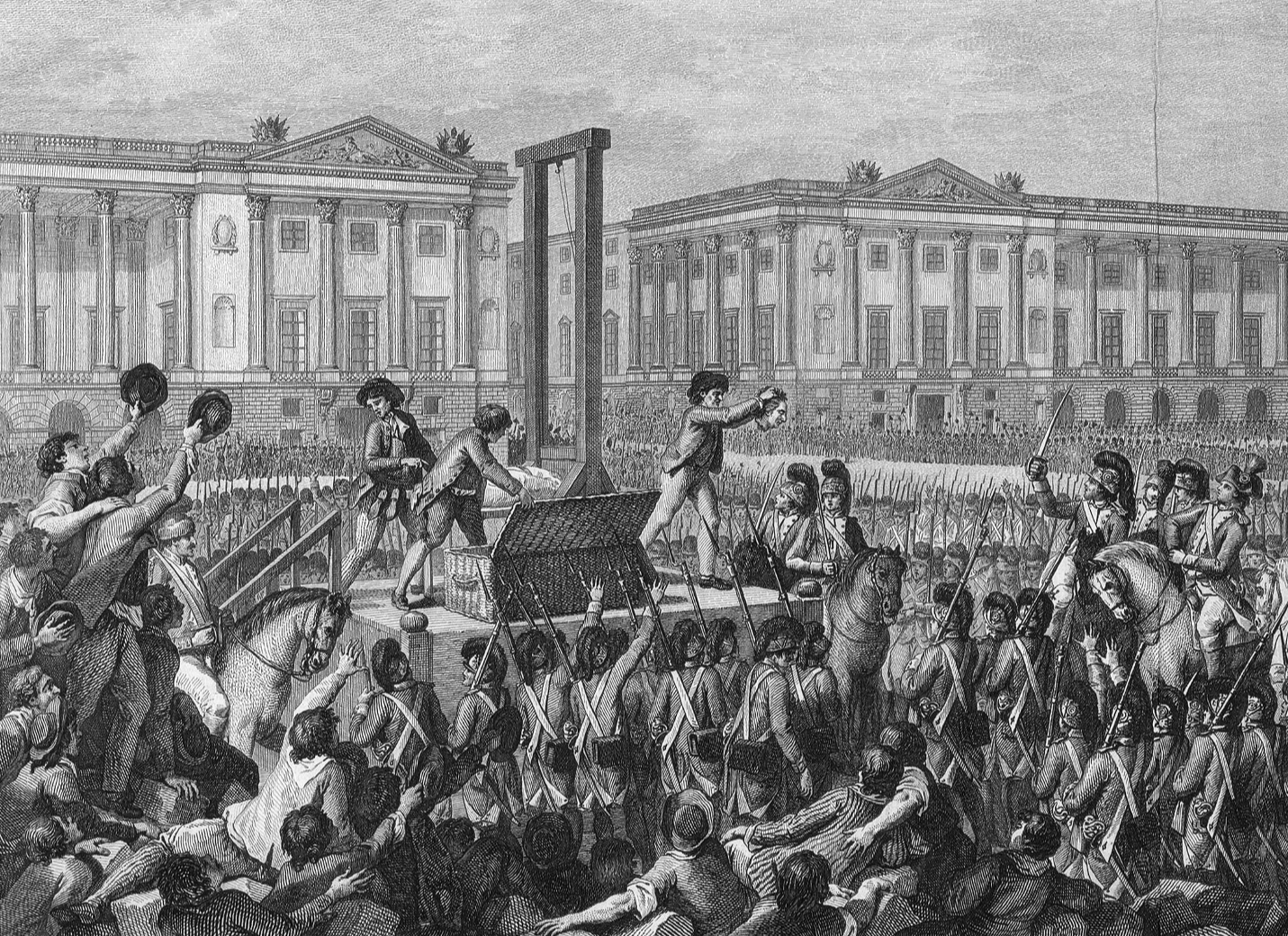
Louis XVI’s execution in the Place de la Révolution (today’s Place de la Concorde), in Paris
A Footnote, and a Walk Along the Quay
There’s a small additional irony that seems fitting to mention, given where our recent post about Benjamin Franklin began.
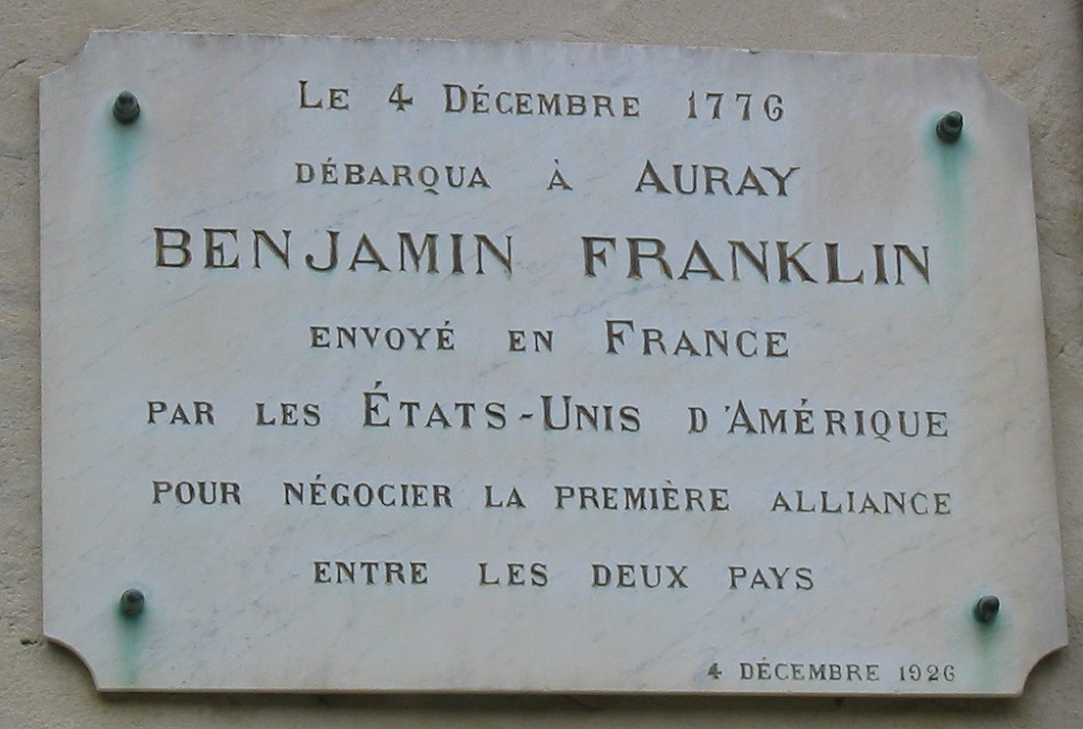
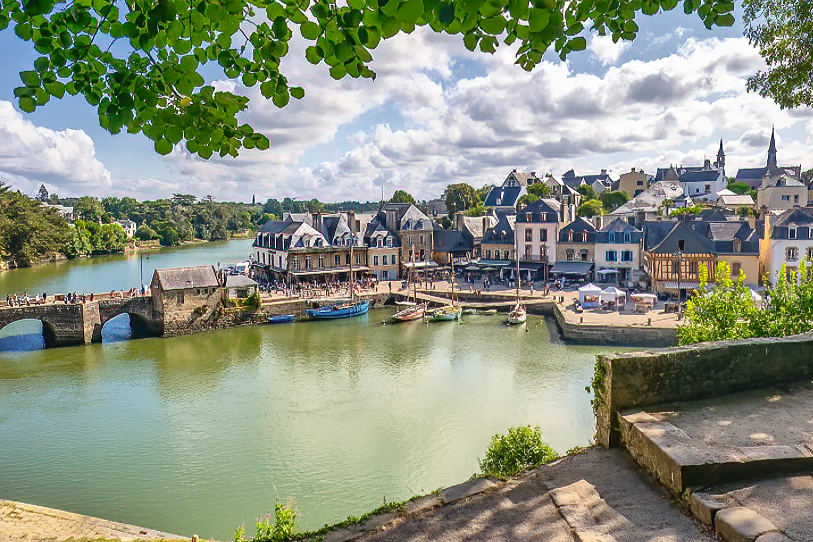
Today, the quay at Auray where Benjamin Franklin stepped ashore in December 1776 is called the Quai Benjamin Franklin. The crêperie with the plaque is called Le Relais Franklin. The town of Auray has, in its own quiet way, never forgotten the connection.
But Auray has another historical claim that the tourist brochures mention less often. In July 1795—six years after the Bastille fell, two years after Louis XVI lost his head, and in the middle of the most violent phase of the Revolution—a group of royalist counter-revolutionaries landed not far from Auray in a doomed attempt to restore the monarchy. They were captured, marched to Auray, and shot. The town that had welcomed the man whose mission helped ignite the Revolution became, a few years later, the site of one of its most brutal reprisals.
History often returns to the places where it started.
(In a letter to British Commander-in-Chief Sir Henry Clinton—who was quartered in New York—Cornwallis issued commendations to several of his officers, including a certain Lieutenant Sutherland, his commanding engineer. [The officers have] “merited in every respect my highest approbation” wrote Cornwallis. We have no idea whether our fearless director is a descendent of that gallant lieutenant. Perhaps. Though one would have expected that line of the family to have been in the navy!)