Saint-Malo

La Route du Rhum 2026

Transatlantic Ocean Racing and one heck of a party in Saint-Malo

Every four years, the corsair city of Saint-Malo is transformed into the beating heart of ocean sailing. The Route du Rhum—destination Pointe-à-Pitre, Guadeloupe—is far more than a yacht race. It’s a celebration of adventure, innovation, and the enduring relationship between Brittany and the sea.

A Legendary Transatlantic Race

The Route du Rhum, first held in 1978, is a single-handed race from Saint-Malo to the Leeward Islands, in the Caribbean. Open to an extraordinary variety of boats, from enormous ocean-going multihulls and cutting-edge IMOCA 60s to smaller monohulls, it brings together some of the world’s finest solo sailors, each testing themselves against the Atlantic and the clock.

The race has always had a certain wonderfully anarchic quality. Unlike events built around a tightly controlled class of virtually identical boats, the Route du Rhum has traditionally celebrated variety. Huge trimarans share the event with much smaller boats; professional campaigns costing millions coexist with sailors whose ambitions are altogether more personal. That diversity is part of its appeal.

But if the race itself is about a transatlantic crossing, the days immediately before it belong to Saint-Malo.
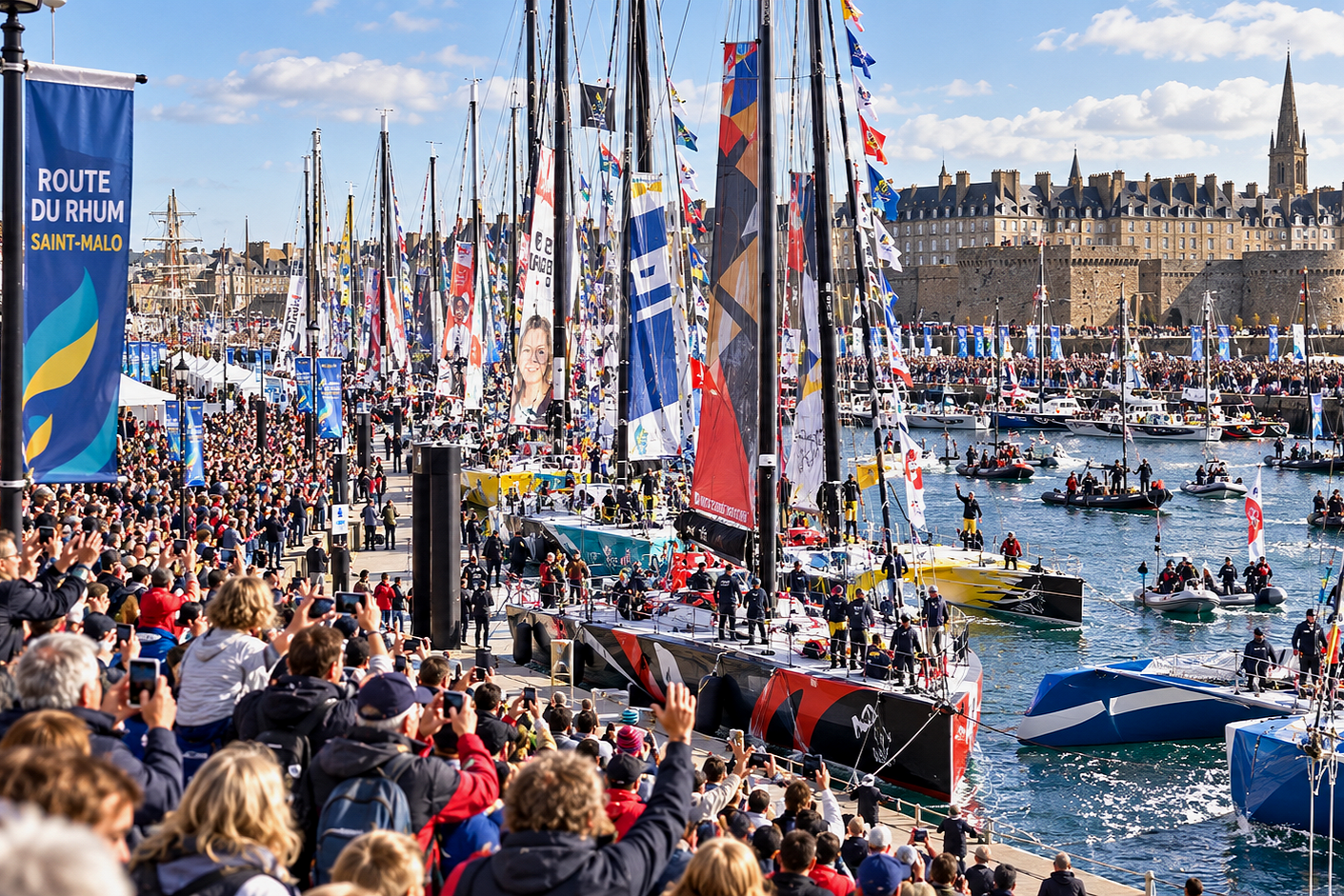
You get the idea. This image was generated by AI based on several copyrighted photographs. It’s a pretty accurate representation of the send-off. You can see actual pics on the official festival website.

Saint-Malo Comes Alive

In the 11 days leading up to the start, Saint-Malo becomes one enormous maritime festival. You can find the event website here: https://www.routedurhum.com/en

The race village spreads around the harbor, while the quays and cobbled streets fill with sailors, families, sailing enthusiasts and hundreds of thousands (the website says “millions”) of curious visitors. Our pilot cutters are relegated to the far reaches of the harbor by the organizers to make room for the participants. The competing boats become attractions in their own right. Some are extraordinary machines, imposing multihulls whose scale is difficult to appreciate until you stand beside one.

There are exhibitions, demonstrations, presentations, concerts, and opportunities to see the boats and their skippers at close quarters. Restaurants and cafés fill. Flags, banners, and pop-up merchants appear everywhere. The harbor becomes a forest of masts. It’s wild.

And of course looming over the entire celebration are Saint-Malo's magnificent granite ramparts.

That setting makes the Route du Rhum somewhat different from an event staged in a purpose-built marina. Saint-Malo brings centuries of maritime history to the party. This was the city of corsairs, explorers, merchants, and fishermen. During Route du Rhum month, the latest generation of carbon-fibre ocean racers sits somewhat incongruously alongside a city whose relationship with the sea stretches back hundreds of years.

The Route du Rhum 2026

This year's Route du Rhum will be the 13th edition of the race, and Saint-Malo will once again become one of the great gathering places of the international sailing world.

For visitors, the attraction isn't simply seeing the start. Much of the magic happens beforehand, as the fleet assembles and the city gradually shifts into festival mode.

That is arguably the best way to experience the Route du Rhum: not merely as a sporting event, but as a Breton fête with a sailing theme.

Walk the quays. Examine the boats. Listen to the languages being spoken around you. Wander through the old city. Eat a galette. Climb the ramparts and look down over a harbor filled with some of the most sophisticated sailing vessels ever constructed.

Then remember where they’re going.

When the fleet finally leaves Saint-Malo—this year on November 1—the sailors turn west and face some 3,500 nautical miles (6,560km) of Atlantic wilderness before reaching Guadeloupe.

More Than a Race

That contrast may be what makes the Route du Rhum so compelling.

In Saint-Malo it is exuberant, crowded and celebratory. At sea it becomes intensely personal. Thousands of spectators give way to seemingly interminable solitude; festival lights give way to stars; the protected harbor gives way to the vast North Atlantic in November.

For anyone visiting Brittany during a Route du Rhum year, the pre-race festivities offer something unusual: a chance to experience serious ocean sailing without ever leaving shore.

And for young people especially, there is another attraction. The Route du Rhum makes sailing seem less like an old-fashioned pastime and more like what it really can be—exploration, technology, competition, self-reliance, and adventure rolled into one.

For a few remarkable days, Saint-Malo becomes the place where all those things converge.

And then, as if somebody flipped a switch, the boats are gone—bound for the Caribbean—the crowds dissipate, and the old corsair city belongs to the locals again. And we get our places back on the quay!

So, we know what you’re asking: how long does it take to make the crossing? The record, set four years ago: 6 days, 19 hours, 47 minutes, and 25 seconds. Wow!

Next June, the Olympic torch is coming to St-Malo!

On 23 June, the Department of Ille-et-Vilaine, in Brittany, announced that the Olympic torch will pass through the “Corsair City” next June. And to mark the announcement they released a video. Here it is—alas, in French. The sailing competitions will be in the Mediterranean, so we’ll be able to sail next summer without disruptions.

Our pilot cutters: before and after

The antifouling begins on one of our pilot cutters

One of our pilot cutters as antifouling wraps up

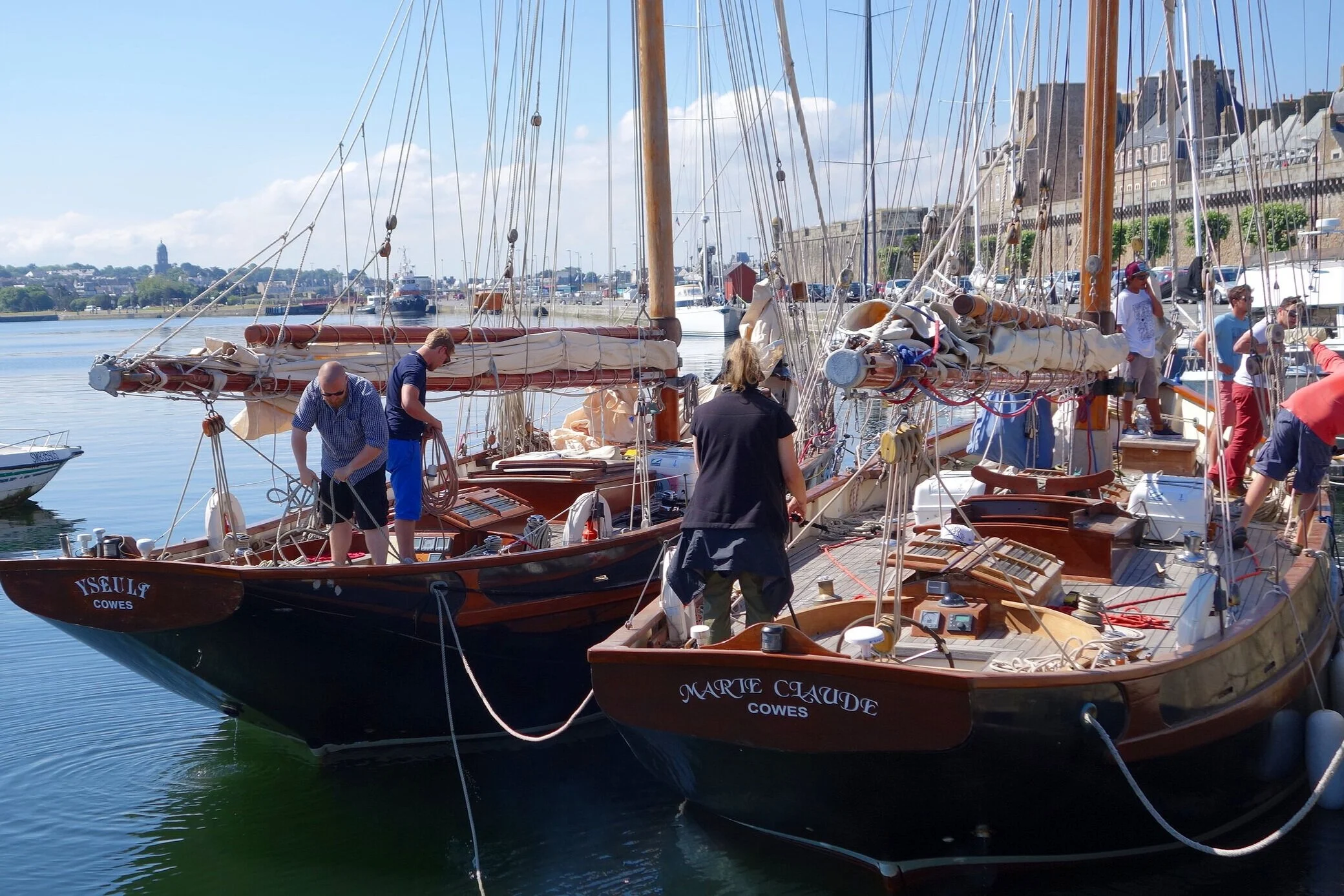
We’re happy to report that three years of crud have been scraped from the hulls of our two pilot cutters, a process known as antifouling. A lot of hard work has gone into getting the boats ready for this season after the horrific “COVID pause.” And look at that sky! How appropriate that, as we prepare to sail again, dark winter clouds have lifted to provide us with some spectacular weather.

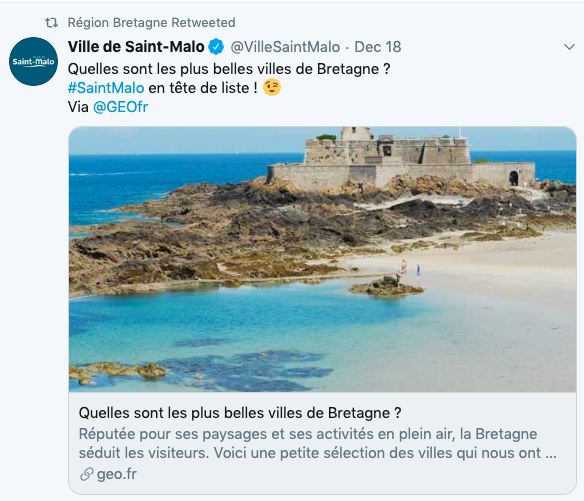
The most welcoming towns in Brittany according to booking.com

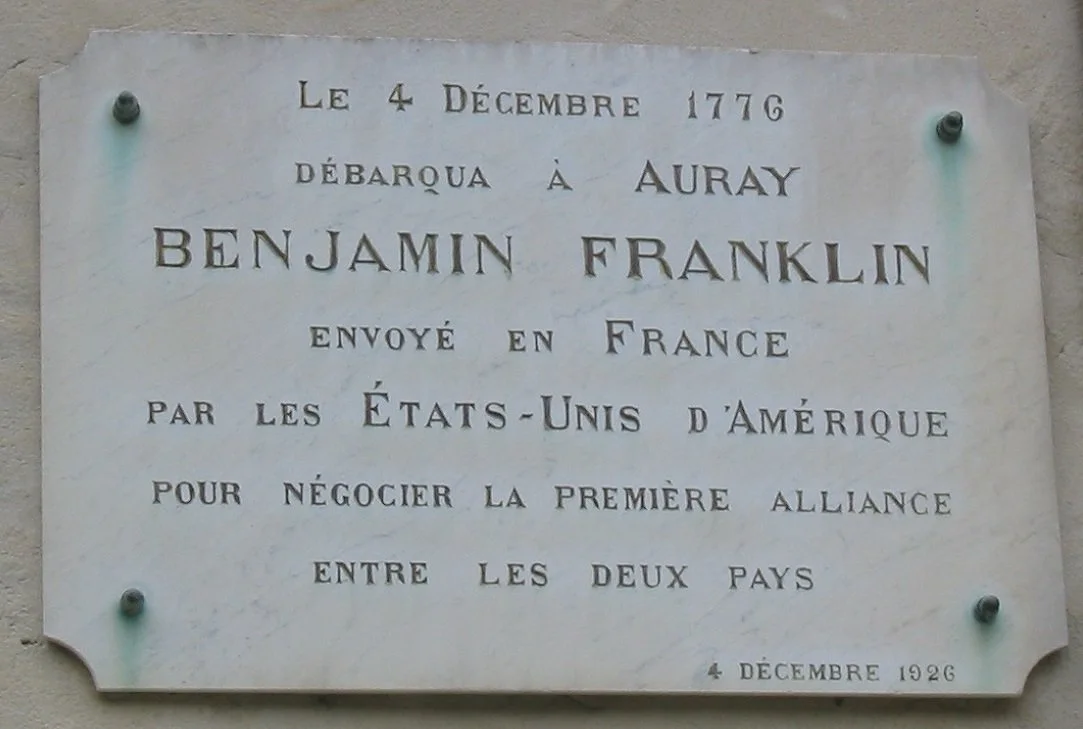
Auray has shown its hospitality to Americans for over two centuries. The plaque says that on December 4, 1776, Benjamin Franklin, as the American envoy to France, disembarked at Auray [on his way to Paris] to negotiate the first alliance between the two countries [or between France and the ASPIRING independent country that, after the 1783 Treaty of Paris, would become the “free, sovereign, and independent” United States of America]. That alliance would provide the American colonists with much-needed military and financial assistance. The American Revolutionary War practically bankrupted France and contributed to the demise of the French monarchy.

(We got this news flash from France Bleu, a network of 44 public radio stations scattered across France)

« Auray en tête, devant Saint-Brieuc et Saint-Malo »

And it says…

“Auray at the top of the list, ahead of Saint-Brieuc and Saint-Malo”

Mais dans la région, c'est Auray, dans le Morbihan, qui remporte le prix de la ville la plus accueillante, se plaçant en 20e position au niveau national. En deuxième place, on trouve Saint-Brieuc (Côtes d'Armor), puis suivent Saint-Malo (Ille-et-Vilaine), Dinan (Côtes d'Armor) et Douarnenez (Finistère). Tous les départements bretons sont donc représentés. 

But in the region [Brittany] it’s Auray, in Morbihan, that wins the prize for the most welcoming town, placing 20th nationally. Saint-Brieuc (in Côtes d’Armor) placed second, followed by Saint-Malo (Ille-et-Vilaine), Dinan (Côtes d’Armor), and Douararnez (Finistère). So all the Breton départements are/were represented.

Selon les commentaires laissés sur Booking.com, "les interactions amicales et les gestes accueillants sont donc particulièrement importants au cours d’un séjour, tout comme la santé et l’hygiène en ces temps incertains marqués par la pandémie de Covid-19 “.

According to reviews left on the website from booking.com travelers, “friendly interactions and welcoming gestures are particularly important during a stay, just as are health and hygiene during these uncertain times, marked by the COVID-19 pandemic.“

**Now, if visitors to Saint-Malo had only stopped by the quay to say “hi,” the “Corsair City” would undoubtedly have placed higher. We are nothing if not welcoming!

Pilot cutters: “the finest sailing boat design ever”

We tell people we take teens on sailing expeditions aboard two classic pilot cutters. And some folks just shrug: “Are we supposed to be impressed?” Well… yes, yes you are. All boats are not created equal. In our last post we featured QBE founder and director Will Sutherland talking about his cutters, built according to a 19th-century French design. But, in fact, our boats are very similar to the famous pilot cutters built to ply the treacherous Bristol Channel, about 200 miles north of Saint-Malo, our home port. Here’s the first part of a documentary by Tom Cunliffe about the history of one of Britain’s most storied boats.

(The first part of the documentary is 16 minutes long.)

“Many consider the Bristol Channel pilot cutter to be the finest sailing boat design ever. Fast, seaworthy and beautiful to behold, the pilot cutter is the perfect combination of form and function - a thoroughbred perfectly adapted to a life in one of the Britain’s most treacherous stretches of water. Sailor and writer Tom Cunliffe explores the life of the pilots and sails a perfectly restored cutter to find out just what drove these men and their wonderful machines.”
”
— From the video description

Maybe Paris’s best summer job. And QBE doing its part for St-Malo tourism

another-cutter-quayside.jpg

A reliable source once told us that the Paris Tourist Board pays (or used to pay) young couples to make out on city benches every summer to provide some romantic ambiance for the throngs of visitors that relentlessly descend on the city, a great job if you can get it. (We can't verify that our information is true, but it sounds like something the “Office Tourism And Convention De Paris [sic]” might do. After all, Disney pays youngsters to dress up as various characters in their theme parks. It seems to work for them, so why not?)
Well, being the civic-minded Malouin denizens we are, we try to provide a similar public service. When people think of St-Malo, they often think of sailing. So we park our eye-popping pilot cutters right alongside the quay for passers-by to gawk at. And they do. Constantly. We wish we had a euro for every time somebody has stood beside one of our boats, smart phone in hand, to pose for for a selfie.