
Transatlantic Ocean Racing and one heck of a party in Saint-Malo
Every four years, the corsair city of Saint-Malo is transformed into the beating heart of ocean sailing. The Route du Rhum—destination Pointe-à-Pitre, Guadeloupe—is far more than a yacht race. It’s a celebration of adventure, innovation, and the enduring relationship between Brittany and the sea.
A Legendary Transatlantic Race
The Route du Rhum, first held in 1978, is a single-handed race from Saint-Malo to the Leeward Islands, in the Caribbean. Open to an extraordinary variety of boats, from enormous ocean-going multihulls and cutting-edge IMOCA 60s to smaller monohulls, it brings together some of the world’s finest solo sailors, each testing themselves against the Atlantic and the clock.
The race has always had a certain wonderfully anarchic quality. Unlike events built around a tightly controlled class of virtually identical boats, the Route du Rhum has traditionally celebrated variety. Huge trimarans share the event with much smaller boats; professional campaigns costing millions coexist with sailors whose ambitions are altogether more personal. That diversity is part of its appeal.
But if the race itself is about a transatlantic crossing, the days immediately before it belong to Saint-Malo.
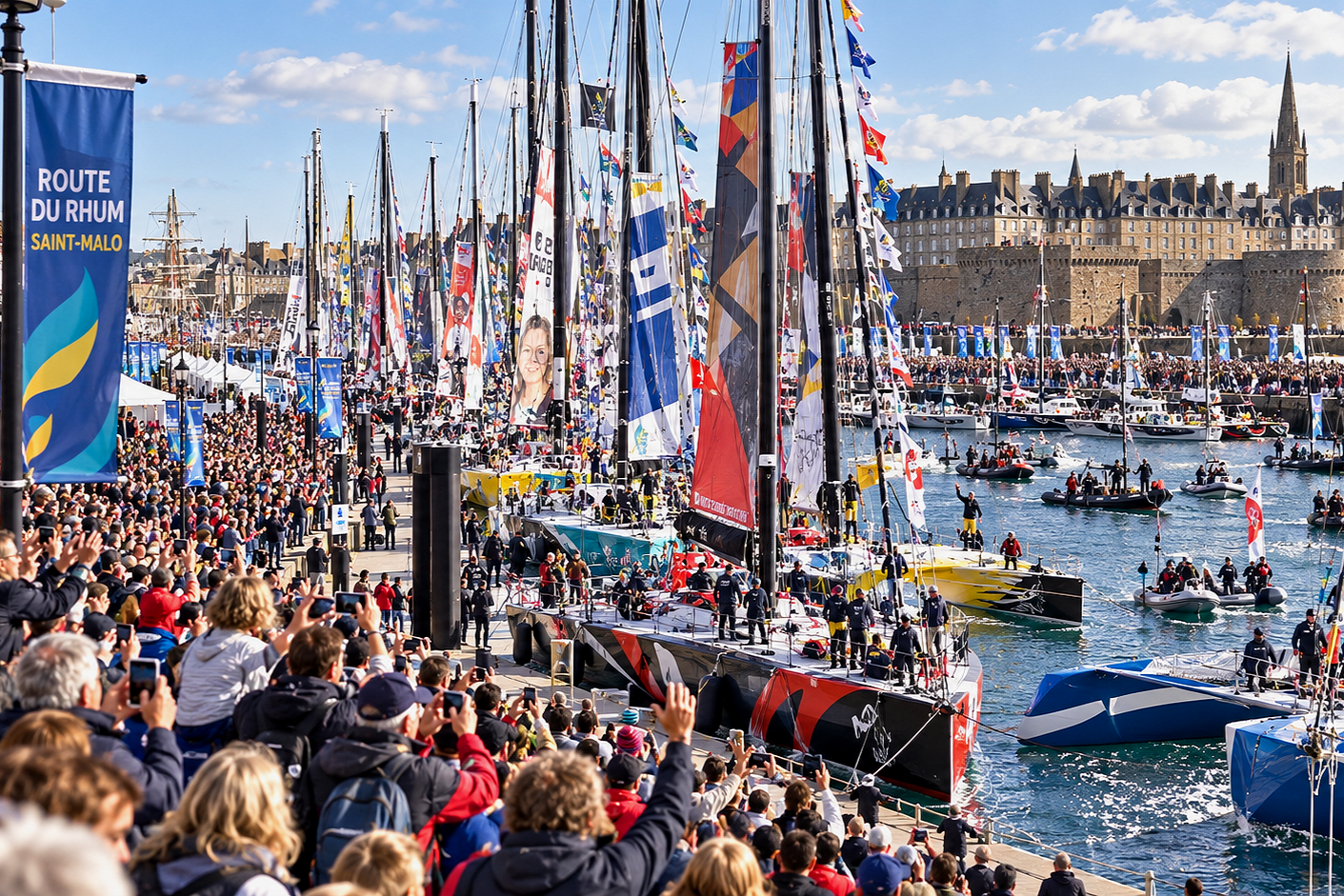
You get the idea. This image was generated by AI based on several copyrighted photographs. It’s a pretty accurate representation of the send-off. You can see actual pics on the official festival website.
Saint-Malo Comes Alive
In the 11 days leading up to the start, Saint-Malo becomes one enormous maritime festival. You can find the event website here: https://www.routedurhum.com/en
The race village spreads around the harbor, while the quays and cobbled streets fill with sailors, families, sailing enthusiasts and hundreds of thousands (the website says “millions”) of curious visitors. Our pilot cutters are relegated to the far reaches of the harbor by the organizers to make room for the participants. The competing boats become attractions in their own right. Some are extraordinary machines, imposing multihulls whose scale is difficult to appreciate until you stand beside one.
There are exhibitions, demonstrations, presentations, concerts, and opportunities to see the boats and their skippers at close quarters. Restaurants and cafés fill. Flags, banners, and pop-up merchants appear everywhere. The harbor becomes a forest of masts. It’s wild.
And of course looming over the entire celebration are Saint-Malo's magnificent granite ramparts.
That setting makes the Route du Rhum somewhat different from an event staged in a purpose-built marina. Saint-Malo brings centuries of maritime history to the party. This was the city of corsairs, explorers, merchants, and fishermen. During Route du Rhum month, the latest generation of carbon-fibre ocean racers sits somewhat incongruously alongside a city whose relationship with the sea stretches back hundreds of years.
The Route du Rhum 2026
This year's Route du Rhum will be the 13th edition of the race, and Saint-Malo will once again become one of the great gathering places of the international sailing world.
For visitors, the attraction isn't simply seeing the start. Much of the magic happens beforehand, as the fleet assembles and the city gradually shifts into festival mode.
That is arguably the best way to experience the Route du Rhum: not merely as a sporting event, but as a Breton fête with a sailing theme.
Walk the quays. Examine the boats. Listen to the languages being spoken around you. Wander through the old city. Eat a galette. Climb the ramparts and look down over a harbor filled with some of the most sophisticated sailing vessels ever constructed.
Then remember where they’re going.
When the fleet finally leaves Saint-Malo—this year on November 1—the sailors turn west and face some 3,500 nautical miles (6,560km) of Atlantic wilderness before reaching Guadeloupe.
More Than a Race
That contrast may be what makes the Route du Rhum so compelling.
In Saint-Malo it is exuberant, crowded and celebratory. At sea it becomes intensely personal. Thousands of spectators give way to seemingly interminable solitude; festival lights give way to stars; the protected harbor gives way to the vast North Atlantic in November.
For anyone visiting Brittany during a Route du Rhum year, the pre-race festivities offer something unusual: a chance to experience serious ocean sailing without ever leaving shore.
And for young people especially, there is another attraction. The Route du Rhum makes sailing seem less like an old-fashioned pastime and more like what it really can be—exploration, technology, competition, self-reliance, and adventure rolled into one.
For a few remarkable days, Saint-Malo becomes the place where all those things converge.
And then, as if somebody flipped a switch, the boats are gone—bound for the Caribbean—the crowds dissipate, and the old corsair city belongs to the locals again. And we get our places back on the quay!
So, we know what you’re asking: how long does it take to make the crossing? The record, set four years ago: 6 days, 19 hours, 47 minutes, and 25 seconds. Wow!