

"Do we need a visa?"
"Will my teenager be able to travel alone?"
"How complicated is all this?"
These are among the most common questions we hear from American parents considering a QBE expedition in France. (And from parents in other far-flung places.)
It's understandable. International travel seems to accumulate new rules every year. Passports. Security checks. Airline apps. Entry requirements. Travel insurance. Permissions for minors.
The good news?
For most American families, getting a teenager to France is remarkably straightforward. In fact, the logistics are often easier than many domestic programs that require multiple flights, lengthy drives, or complicated drop-off arrangements.
What American Families Actually Need To Get Here
For a typical QBE expedition, the travel logistics are surprisingly simple:
✅ A valid U.S. passport
✅ A round-trip airline ticket
✅ Standard travel consent paperwork (for minors traveling without a parent)
✅ A modest amount of spending money. (We pay for meals and admissions.)
That's essentially it.
American citizens are allowed to visit France and the rest of the Schengen Area for short stays without obtaining a traditional visa in advance. France welcomes millions of American visitors every year, including large numbers of students.
"But My Teen Has Never Flown Overseas Alone."
Neither had many of our previous young crew members.
Every summer, young people arrive from across the United States—and from numerous other countries worldwide. For most, the journey is far less intimidating than they imagined.
A typical itinerary might look something like this:
San Francisco → Paris
Chicago → Paris
New York → Paris
Dallas → Paris
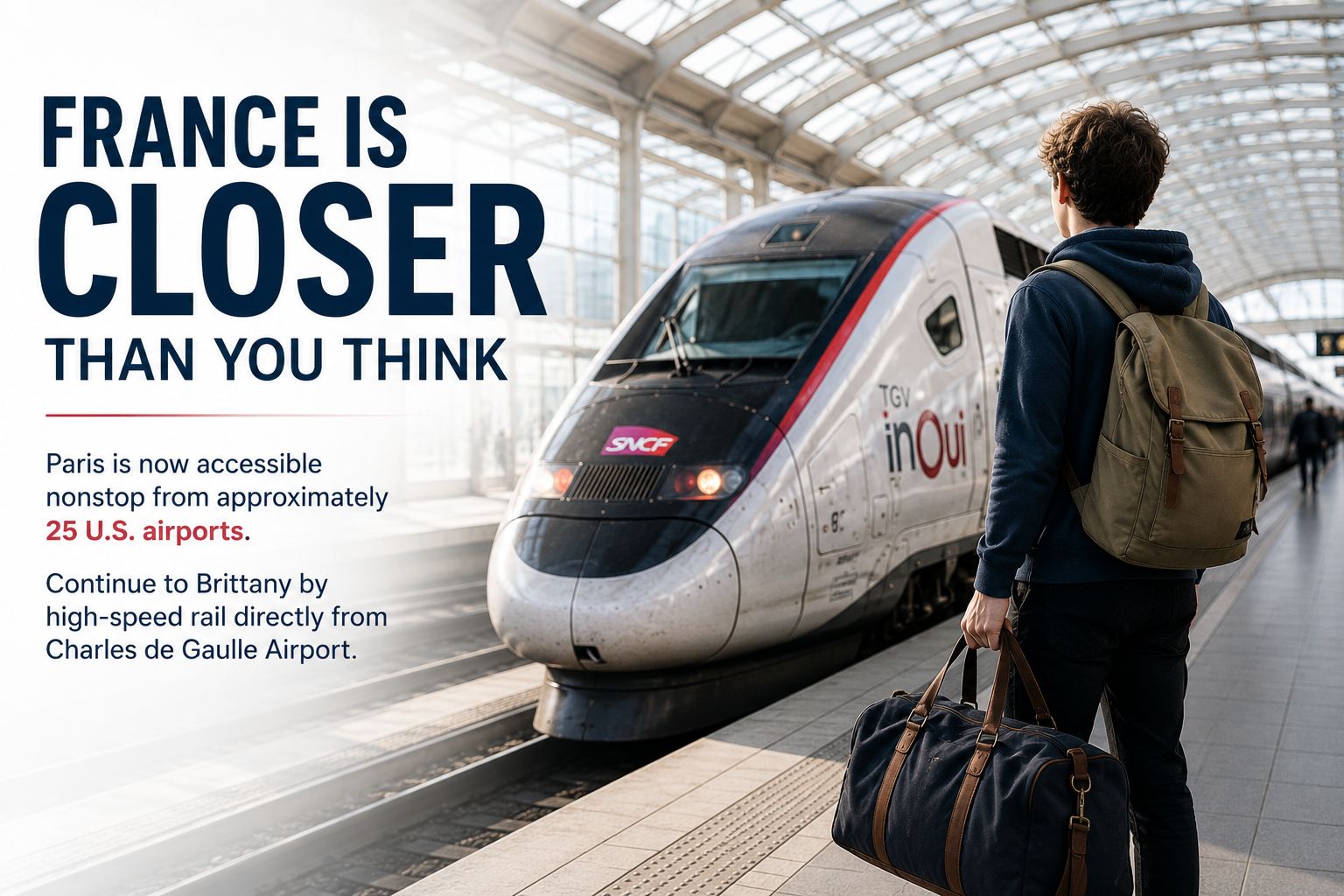
In fact, today, students can reach Paris nonstop from about 25 U.S. cities. Others require only a single connection.
Upon arrival, participants arriving at Charles de Gaulle (CDG) can catch a bullet train (TGV) directly to St-Malo. Expeditioners arriving at other airports follow straightforward instructions to meet our staff at a designated location before continuing on to Brittany.
Parents are often surprised by how capable their teenagers become once given the opportunity.
What About Safety?
Parents naturally worry about sending a teenager overseas. So do we.
Our approach is simple:
• Small groups.
• Experienced staff.
• Clear procedures.
• Thoughtful supervision.
For decades, we've welcomed young people from around the world to Brittany while maintaining an impeccable safety record.
Our staff-to-student ratio is approximately 1:3—far more personal than most youth travel programs.
The Real Challenge Isn't the Logistics
The paperwork usually takes less time than families expect.
Booking a flight is easier than ever. Airlines move millions of passengers between the United States and Europe every year. The bigger challenge is often psychological. For parents, it's allowing a teenager to step into an unfamiliar world. For teenagers, it's saying “yes” to an adventure that stretches them.
Yet those moments of uncertainty are often where the confidence begins to grow.
A Different Kind of Summer
Every year, parents tell us some version of the same story:
"We were worried about sending our child overseas."
A few weeks later, those same parents are listening to stories about navigating challenging coastlines, making friends from other countries, exploring medieval towns, and discovering capabilities they never knew they had.
The passport, the flight, and the paperwork are merely the opening chapter and surprisingly easy.
The journey really gets interesting when we cast off.