
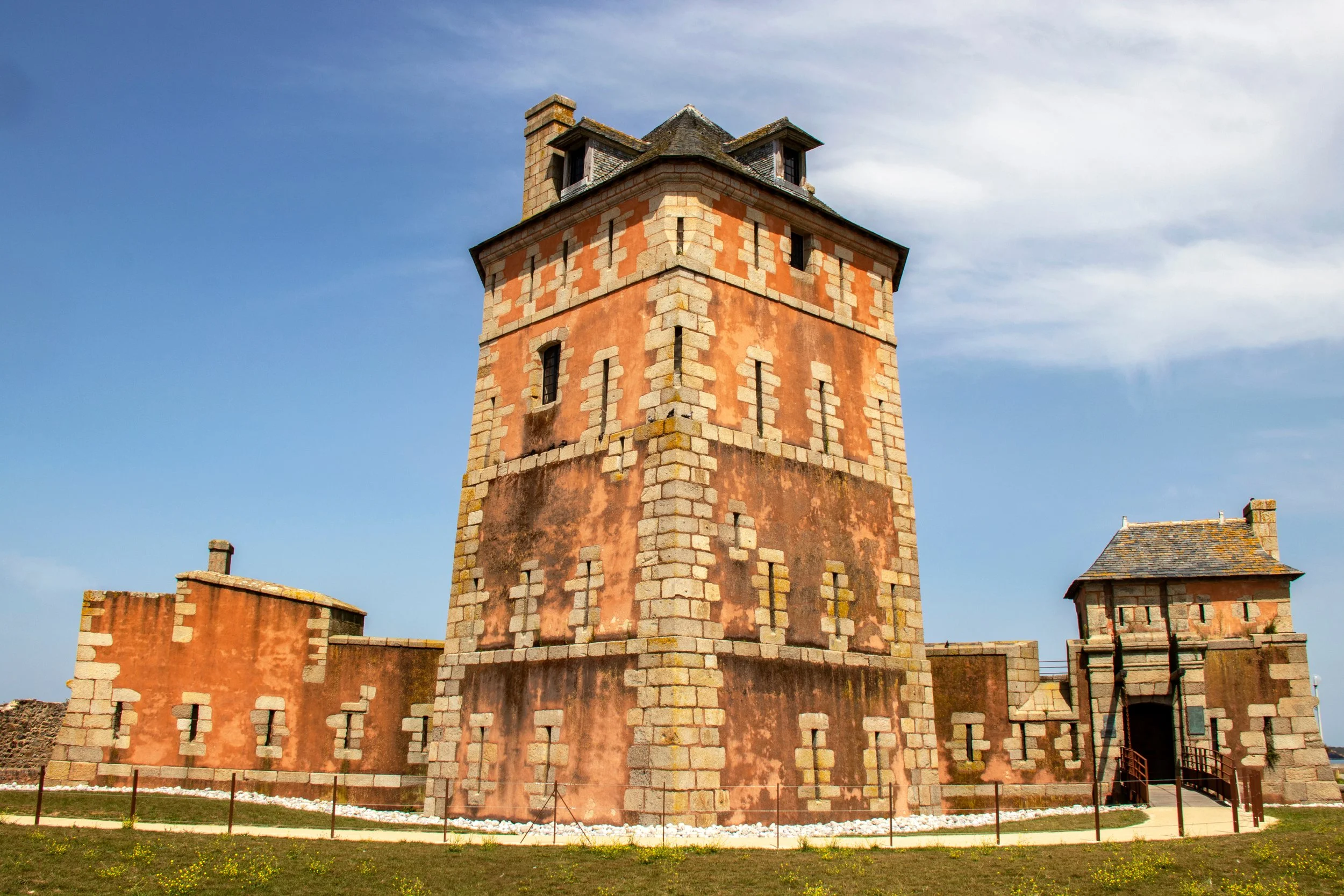
La Tour Vauban in Camaret-sur-Mer, near Brest
The star-shaped fortifications you see from the deck of a QBE cutter were designed by one of the most remarkable, and most contradictory, Frenchmen of the 17th century.
Somewhere between Brest and the Channel Islands, if you’re sailing the coast of Brittany on a clear day, you’ll see a tower. It sits at the tip of the Crozon Peninsula, at the entrance to the harbor of Camaret-sur-Mer. The hexagonal tower, built of golden stone, and has stood on that exact spot since 1694. It's not large—a handful of soldiers could man it—but it’s exactly where it needs to be, commanding the approach to Brest, covering the battery on the shore below it, part of a constellation of coastal defenses that stretches for miles in either direction.
It is, in other words, a Vauban fortification. And once you know what to look for, you start seeing them everywhere along the coastline.
The Man Behind the Star

Sébastien Le Prestre de Vauban
Sébastien Le Prestre de Vauban was born in 1633 in a small village in Burgundy, the son of minor provincial nobility. His father died when he was ten, leaving the family in poverty. A Carmelite prior in the local town took him in and gave him the only formal education he would ever receive: mathematics, geometry, the basics of surveying. It was enough.
At seventeen, Vauban enlisted as a soldier in the regiment of Louis de Bourbon, Prince de Condé, who was at that moment leading a rebellion against the young Louis XIV. Within a year, Vauban had distinguished himself sufficiently in battle to be offered a commission, which he declined, because he couldn't afford the uniform. Condé put him to work fortifying towns instead.
In 1653, Vauban was captured by royalist troops. What happened next defined the rest of his life: rather than being punished as a rebel, he was interviewed by Cardinal Mazarin, Louis XIV’s chief minister, who was sufficiently impressed to offer him a place in the royal army. Vauban switched sides—which was common practice in 17th-century France, where loyalty followed patronage more than principle—and devoted the next fifty years of his life to the service of the king who had just been his enemy.
It was a devotion that would cost him everything, eventually. But not before it changed the face of France.
The Science of the Star
The problem with medieval fortifications—high walls, round towers, vertical stone faces—was vulnerability to cannon fire. By the mid-17th century, artillery had advanced to the point where a sufficiently determined attacker with enough firepower could simply blast a hole in a vertical wall and walk through it. The great castles of the Middle Ages, which had taken generations to build, were becoming increasingly obsolete.
Vauban’s solution was the star-shaped bastion fort, and while he didn’t invent it—Italian engineers had developed the concept a century prior—he refined it, systematized it, and adapted it with a flexibility and precision that no one before him had achieved.
The principle is elegant: instead of high vertical walls that present a flat face to enemy artillery, you build low, angled ramparts of earth and stone that deflect cannonballs rather than absorbing them. The projecting points of the star—the bastions—eliminate blind spots by allowing defenders to cover every angle of the wall with flanking fire. Attackers approaching along any line of advance are exposed to fire from at least two directions simultaneously. There is nowhere to hide.
Vauban replaced fortresses whose medieval walls would crumble at the first cannonball with star-shaped bastions surrounded by a series of defenses that would slow attackers and increase firepower. The attacker’s problem was no longer how to knock a wall down. It was how to cross the killing ground in front of it.
Vauban also revolutionized the art of the siege from the other side—the attacking side. He developed a systematic approach using parallel trenches, connected by zigzag approach lines, that allowed attacking troops to advance on a fortification under cover, bringing artillery forward in stages, methodically reducing the defensive advantage until a breach became inevitable. He personally directed or participated in more than 40 sieges over his career, and he was on the winning side every single time.
This was not lost on Louis XIV. Viewing civilian infrastructure as closely connected to military effectiveness, Vauban upgraded many of France's major ports, as well as such new projects as the Bruche Canal. He was eventually appointed Commissioner General of Fortifications—effectively the chief engineer of France—and over the course of his career he redesigned or modernized more than 130 existing fortifications and built approximately 30 new ones from scratch. He also designed entire towns—Neuf-Brisach, on the Rhine, is an octagonal planned city built entirely according to his principles, a geometric masterpiece that still looks today exactly as he imagined it.
The result was what Vauban called the pré carré—the "square meadow" — a double belt of fortified towns and strongholds running along France's northern and eastern frontiers, interlocking and mutually supporting, designed so that any invading army would have to reduce one fortress after another before it could penetrate to the French heartland. It was, in effect, a national security system, a Maginot Line before its time. And it worked.
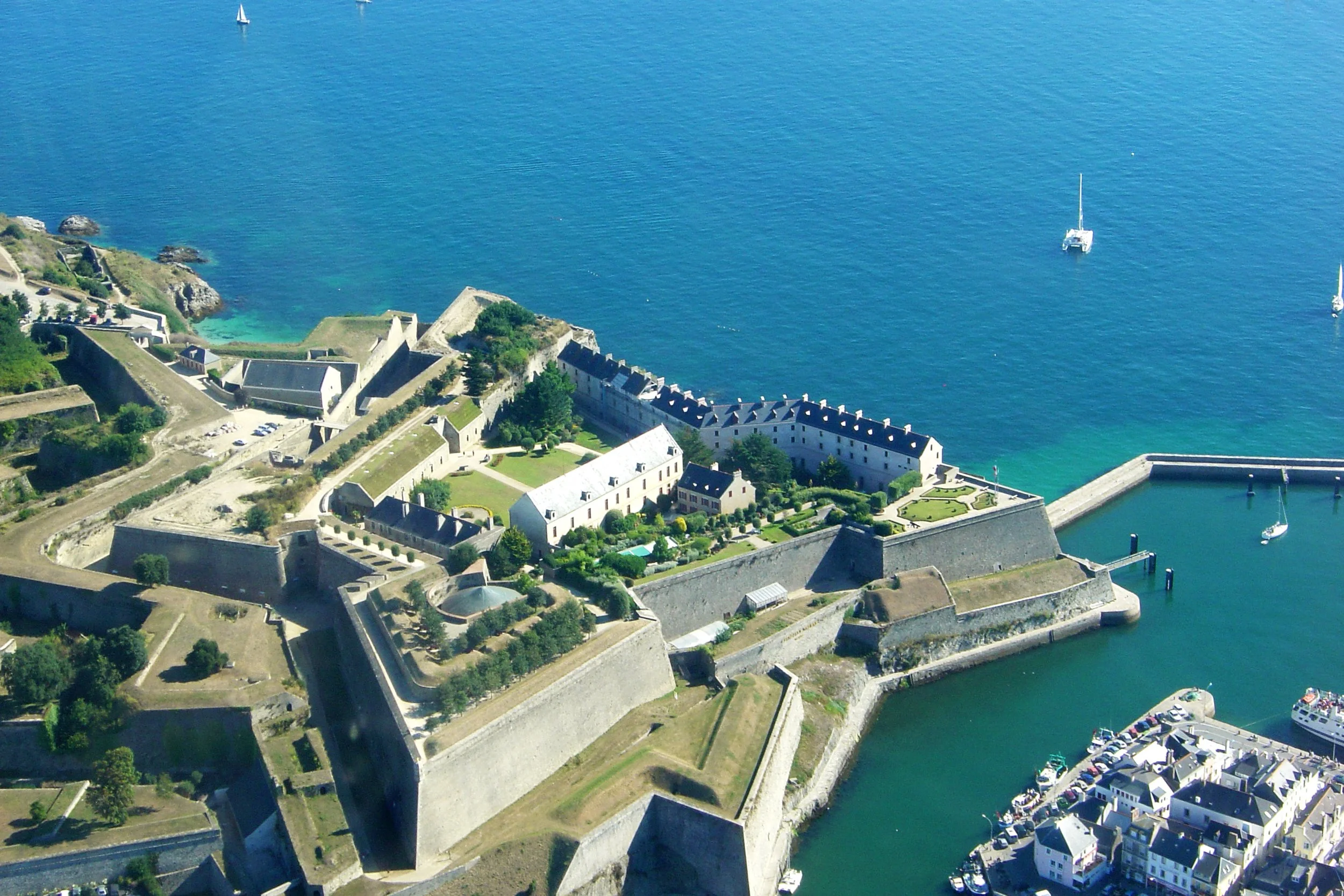
The citadel at Belle-Ile-en-Mer
What You See from the Water
Two of the twelve UNESCO-listed Vauban sites are visible from or closely accessible to QBE's sailing area.
• The Tour Vauban at Camaret-sur-Mer, at the tip of the Crozon Peninsula in Finistère, was completed in 1694, just in time to prove its worth. On June 18 of that year, an Anglo-Dutch fleet attacked the harbor of Brest—the most important French naval base on the Atlantic—and was turned away. The tower and its battery performed exactly as designed. The king rewarded Camaret with a full exemption from taxes, a royal favor that lasted until the Revolution. The tower still stands at the harbor entrance, golden and slightly incongruous among the fishing boats, looking out over the same approaches it was built to defend.
• Saint-Vaast-la-Hougue, on the Normandy coast near the Cotentin Peninsula, offers a different kind of Vauban sight: two towers, one on the mainland and one on the tiny island of Tatihou, facing each other across the bay. They were built after a humiliating French naval defeat in 1692, when an Anglo-Dutch fleet destroyed a French squadron attempting to support a Jacobite restoration in England. Louis XIV commissioned Vauban to make sure it never happened again. The towers are squat and functional, 21 meters wide, built on four-pointed star-shaped earthworks, with a moat. They have been looking at each other across the water for 330 years.
Both sites repay a visit—not just as pieces of military architecture but as objects of meditation on what it means to build something intended to outlast everything around it. Vauban’s fortifications were designed for permanence. The wars they were built for are long over. The towers remain.
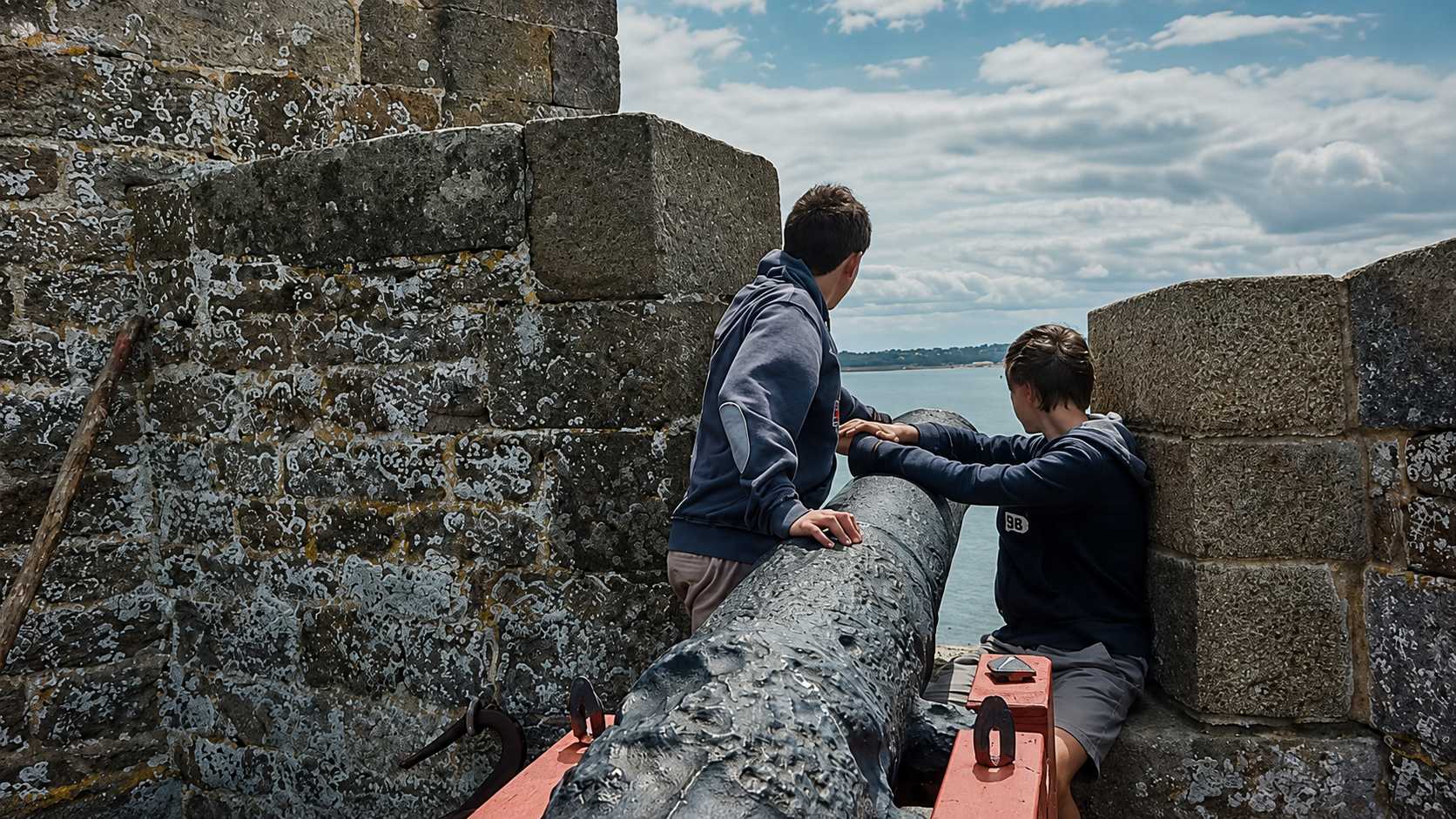
Two QBE crew members looking out over the Bay of Saint-Malo from ramparts designed by Vauban
The Pamphlet That Ended Everything
Here is where Vauban’s story takes an interesting turn.
For fifty years, he traveled the length and breadth of France conducting censuses, inspecting fortifications, building roads and canals, corresponding with the king on everything from pig farming to foreign policy. He saw the country from the ground up, in a way that almost no one else of his era did. And what he saw disturbed him profoundly.
He was curious about everything, and sent memos back to the King on a variety of subjects, ranging from foreign politics and taxes to the dangers of the revocation of the Edict of Nantes. He endeavoured in particular to denounce the great poverty of a people afflicted by war, harsh winters, and famine.
The France that Vauban saw was not the France of Versailles. It was a country where peasants whose labor, he wrote, "the main foundation of all wealth" were being crushed by a tax system of staggering inequity. The nobility paid almost nothing. The clergy paid almost nothing. The burden fell on those least able to carry it.
In 1707, at the age of 73, Vauban published his solution: La Dîme Royale: “The Royal Tithe.” It proposed abolishing the existing tangle of indirect taxes and replacing them with a 10 percent flat tax on all income—agricultural, commercial, and industrial—with no exemptions. Not for the nobility. Not for the clergy. Not for anyone.
He backed his argument with statistics—census data he had collected himself over decades of travel—making it, as one historian has noted, one of the founding documents of modern economic policy.
Louis XIV reacted with predictable fury. The manuscript was quietly banned and it vanished from circulation. At court, people avoided Vauban. The man who had spent half a century building France’s defenses, who had directed more than 40 successful sieges, who had been wounded eight times in the king's service, was sidelined and disgraced for the crime of pointing out that French peasants were starving.
Although his work was confiscated and destroyed by royal decree, the use of statistics to support his arguments established him as “a founder of modern economics, and precursor of the Enlightenment’s socially concerned intellectuals.”
Vauban retreated to his estate at Bazoches, in Burgundy, ill with pneumonia, spending his last weeks trying to collect every copy of La Dîme Royale that he had privately circulated to friends. He failed to collect them all. On March 30, 1707—just weeks after the pamphlet’s publication—he died in his Paris home, in the arms of his son-in-law. His funeral was modest. France was at war, the treasury was empty, and the court had other priorities.
He was buried at Bazoches. But Napoleon, who had a sharp eye for useful precedents, later ordered Vauban’s heart transferred to Les Invalides in Paris, the national shrine of French military glory, as a posthumous honor. The heart of the man who built France’s walls and then tried to tear down its tax code, rests there today, a few hundred meters from Napoleon’s own tomb.
The ideas in La Dîme Royale—the pamphlet that led to Vauban’s disgrace—went on to inspire the Physiocrats, the Enlightenment economists who in turn influenced the architects of the French Revolution. The flat tax on all income regardless of social rank: this was, in essence, what the Revolution eventually demanded. Vauban was, without really meaning to be, another person who helped set the table for 1789.
A Walk Around the Walls
When a QBE crew ties up in Camaret-sur-Mer and walks along the harbor to look at the Tour Vauban, what they’re looking at is a structure that has been standing on that exact spot for 330 years. It has survived the wars it was built for, the Revolution that swept away the monarchy that built it, two World Wars, and the slow gentrification of a coastline that was once largely militarized.
It’s also, in its geometry, a piece of genuine intellectual achievement—a problem solved with mathematics and materials science and a deep understanding of how human beings behave under fire. Vauban was not primarily a theorist. He was a man who worked in mud, stone, and cannon smoke and spent years traveling roads that sometimes were infested with highwaymen. His fortifications worked because they were built for purpose by someone who understood, from experience, the threats evolving military strategies and weaponry posed.
The star shape in the landscape. The golden tower at the harbor entrance. The two towers watching each other across a Norman bay. They were built by a man who spent his life in the service of a king, and ended it by telling that king something he didn't want to hear.
Vindication sometimes takes a while.
The Tour Vauban at Camaret-sur-Mer is a UNESCO World Heritage Site. The towers at Saint-Vaast-la-Hougue and Tatihou Island are also part of the UNESCO Vauban network. Both sites are accessible from the water.