
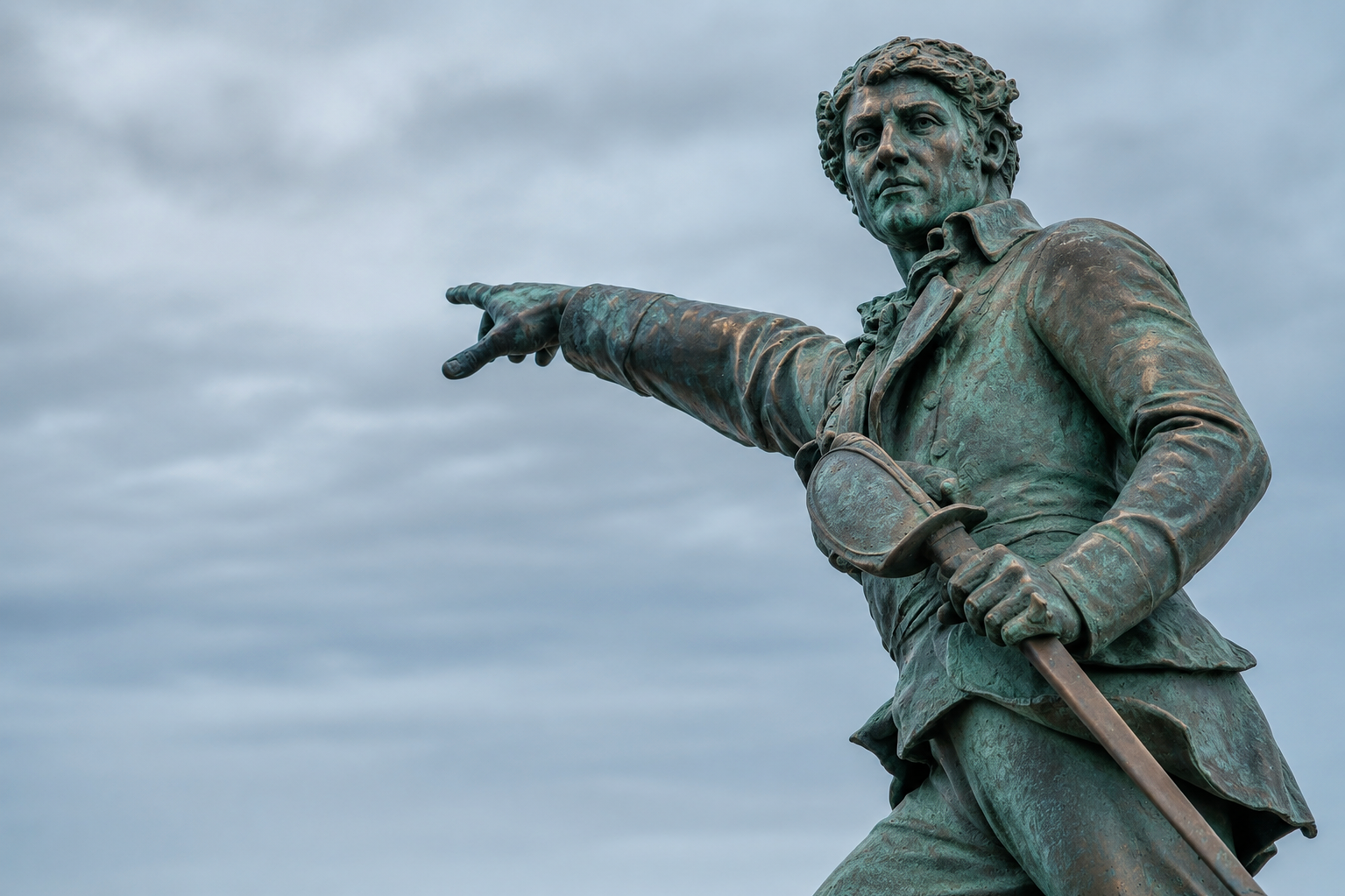
Bronze statue of Robert Surcouf, the “King of the Corsairs”, in Saint-Malo, pointing across the English Channel toward England
Our home port has a complicated relationship with the law.
It always has.
Walk the ramparts of Saint-Malo on any summer evening and you’ll pass two bronze statues looking out to sea. One is René Duguay-Trouin, born in this city in 1673, who went to sea at fourteen, commanded his first warship at eighteen, captured more than 300 enemy vessels over his career, and sacked Rio de Janeiro. The other is Robert Surcouf, born here exactly a century later, who earned the title “Roi des Corsaires”— King of the Corsairs—by capturing 47 ships including a 1,200-ton East India Company vessel, and who died in 1827 as one of the wealthiest men in Brittany.
They are not looking out to sea because of the spectacular view. They are looking out to sea because that is where the money was.
Saint-Malo calls itself the Corsair City , “la Cité Corsaire,” and the title is not tourism branding. For nearly three centuries, from the 16th to the 19th, this granite-walled port on the border of Brittany and Normandy was the most notorious privateer base in France, possibly in Europe. Understanding what that means—and why it’s more interesting than it first sounds—requires understanding an important distinction.
Corsair vs. Pirate: An important distinction.
A corsair is not a pirate. The distinction is actually legal, and in Saint-Malo, it matters enormously.
A pirate operates outside the law, for his own gain, against anyone he chooses. In centuries past, if captured, he was hanged—no trial, no quarter. A corsair, by contrast, operated under a royal commission called a lettre de marque or lettre de course—a document issued by the king, authorizing a private vessel to attack the ships of enemy nations during wartime. Seized vessels and their cargo were sold at auction, with the corsair captain entitled to a portion of the proceeds, along with the crown. Captured corsairs were treated as prisoners of war rather than criminals. They were doing what the king had commissioned them to do.
The corsair, in other words, was an outsourced naval officer. A privateer. A licensed predator. He made war on the king’s enemies, paid the king a cut of his winnings (10–33%), and operated within a legal framework that protected him—at least in theory, and at least in French ports—from the gallows.
The word itself tells the story: corsaire derives from the Italian corsare, which comes from the Latin cursus: a course, a run. The corsair ran down and plundered enemy ships for profit and for crown. This distinction is what has saved the reputations of Saint-Malo’s most celebrated maritime figures from the word “pirate,” a word the city finds distinctly unflattering (though there are several shops in town that happily sell “pirate tackle” to tourists).
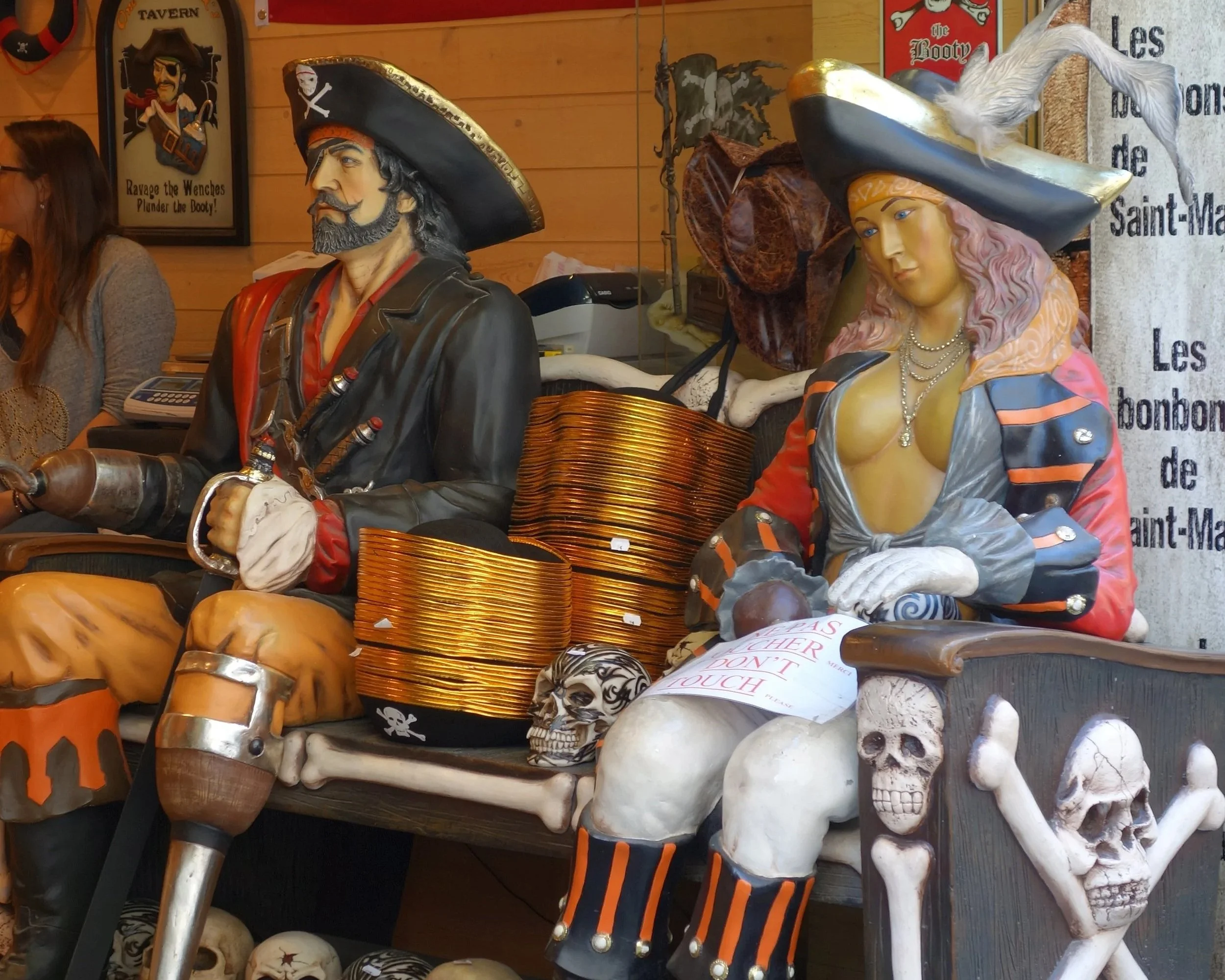
One of the many shops in St-Malo selling various pirate paraphernalia
The City That Privatized Naval Warfare
Why Saint-Malo? The geography answers the question before history does.
Stand on the ramparts and look out. The city sits at the mouth of the Rance estuary, on a rocky tidal island, historically accessible only by a narrow causeway at low tide, with a deep-water harbor capable of handling large vessels and a coastal position commanding the English Channel shipping lanes. Everything that passed between England and France, between the Atlantic and the North Sea, between the Caribbean trade routes and the ports of northern Europe, had to pass close to Saint-Malo.
For a city whose economy depended on maritime trade, perpetual war with Britain—which France was engaged in, with varying intensity, for most of the 17th and 18th centuries—was a commercial catastrophe in peacetime and an extraordinary bonanza in wartime. When the king issued lettres de marque, Saint-Malo’s merchants and shipowners pivoted instantly: merchant vessels were rearmed, experienced seamen were signed on as privateers, and the ships that had been trading peacefully between Brittany and the world became licensed predators in the Channel.
The city had been declared a free port in the Middle Ages, and its citizens had a long tradition of independence so fierce that they had briefly declared themselves a republic in 1490, free from both the French crown and the Duchy of Brittany. There is a Malouin saying, still quoted today: Ni Français, ni Breton, Malouin suis: “Neither French nor Breton, I am Malouin.” The corsairs were an expression of that same independent, entrepreneurial spirit applied to naval warfare.
Vauban himself (see blog post below), whose fortifications still guard the approaches to the harbor, understood the strategic value of what Saint-Malo offered. He wrote a Mémoire sur la Caprerie, a memorandum on privateering in which he argued that since the English and Dutch possessed superior conventional fleets, France’s best strategy was to attack their commercial shipping, the source of their wealth, through state-sanctioned corsairs operating out of well-defended ports. Saint-Malo was his exhibit A.
The British became so fed up with the privateering that in 1693, in an effort to blow the city up, they built a floating bomb called the “Infernal Machine”—a 300-ton ship packed with gunpowder, pitch, and shrapnel and directed it right at the city walls. Alas, the British captain misjudged the tide and a rock detonated the 17th-century “bunker-buster” before it could get close enough to do much damage. The only reported casualties were an unfortunate cat on the ramparts and a few blown-out windows.
The Two Greatest Corsairs
René Duguay-Trouin was born in 1673 to a wealthy Saint-Malo shipowning family. When he was expelled from school at 14, his parents sent him to sea. The sailing life apparently appealed to him. By 18 he was in command of a corsair vessel. By 21 he commanded a 40-gun ship and was capturing enemy vessels in the Channel for Louis XIV.
His career spans the entire range of what a corsair could be. At the peak of his seafaring days he commanded a fleet of 64 ships and, over the course of his career, was credited with capturing more than 300 merchant vessels and 20 warships. His most audacious exploit came in 1711—to avenge a French defeat and win the release of prisoners, he led a squadron of 16 warships across the Atlantic to Rio de Janeiro, then a Portuguese city, and captured it, extracting a ransom of sugar, gold, and the return of French prisoners. He was eventually appointed Lieutenant General of the Naval Armies of France, the equivalent of an admiral, and died peacefully in Saint-Malo in 1736.
He is buried in the iconic Cathedral of Saint-Vincent, whose impressive spire dominates the city’s skyline. (The church also holds Noguette, a bell Duguay-Trouin brought back from Rio de Janeiro. The bell once rang the nightly curfew. It marked the hour when 24 fierce mastiffs were unleashed into the walled inner city to protect the peace. It still rings at 10pm, though the dogs happily have been called off.)
Robert Surcouf was born a century later, in 1773, into a family that had been in the corsair trade for generations—his great-grandfather had captained a privateer under Louis XIV. Surcouf shipped out for the first time at 13 and had his own command at 22. His theater of operations was not the Channel but the Indian Ocean, where he harassed British shipping on the routes to India with a ferocity that earned him the nickname “Tiger of the Seas.”
His most celebrated exploit came in 1800, when he captured the Kent—a 1,200-ton East India Company vessel armed with 38 guns—with a three-masted corvette, the Confiance, carrying just 24 guns and a crew of 160 men against the Kent’s complement of 437. The encounter lasted one hour and 45 minutes. Surcouf lost 13 men. The British lost over 90. The capture made him famous across Europe, but infamous in England. Here is an excerpt of an account of the incident that appeared in a British publication, The Gentleman’s Magazine, Volume 71, Part 1, in 1801:
Bengal, Oct. 8. With great concern we announce the capture of the Kent East Indiaman yesterday, in the Bay of Bengal, off the Sand Head, by the Confiance French privateer… in which Captain Rivington, of the Kent, was unfortunately killed, bravely defending the Company's property till the last moment of his existence, when he exclaimed, “Do not give up the ship.” [13 years before American Navy captain James Lawrence famously said it, on June 1, 1813!]
The crew of the Confiance were all armed with sabres and pistols, and had been thrice encouraged with liquor, previously to their boarding…The gallant Captain Pilkington, the General’s aid de-camp [sic], was severely wounded in defending the General’s family. The French behaved with a cruelty almost unexampled in sea-fights, giving no quarter, and stabbing with their sabres even the sick in their hammocks… In violation of the rights of humanity, as those of war, the Commander of the banditti who took them pillaged them of every article of wearing apparel, and, after having done so, put them, including six ladies, in an open Arab boat…
Oh my! Of course, French accounts tell a different story: that after approximately an hour of permitted looting, Surcouf stopped the pillaging, specifically protected the female passengers, and posted sentries outside their quarters. They also say the passengers were subsequently transferred to a merchant vessel rather than abandoned at sea “in an open Arab boat.” Alas, somewhat different national narratives.
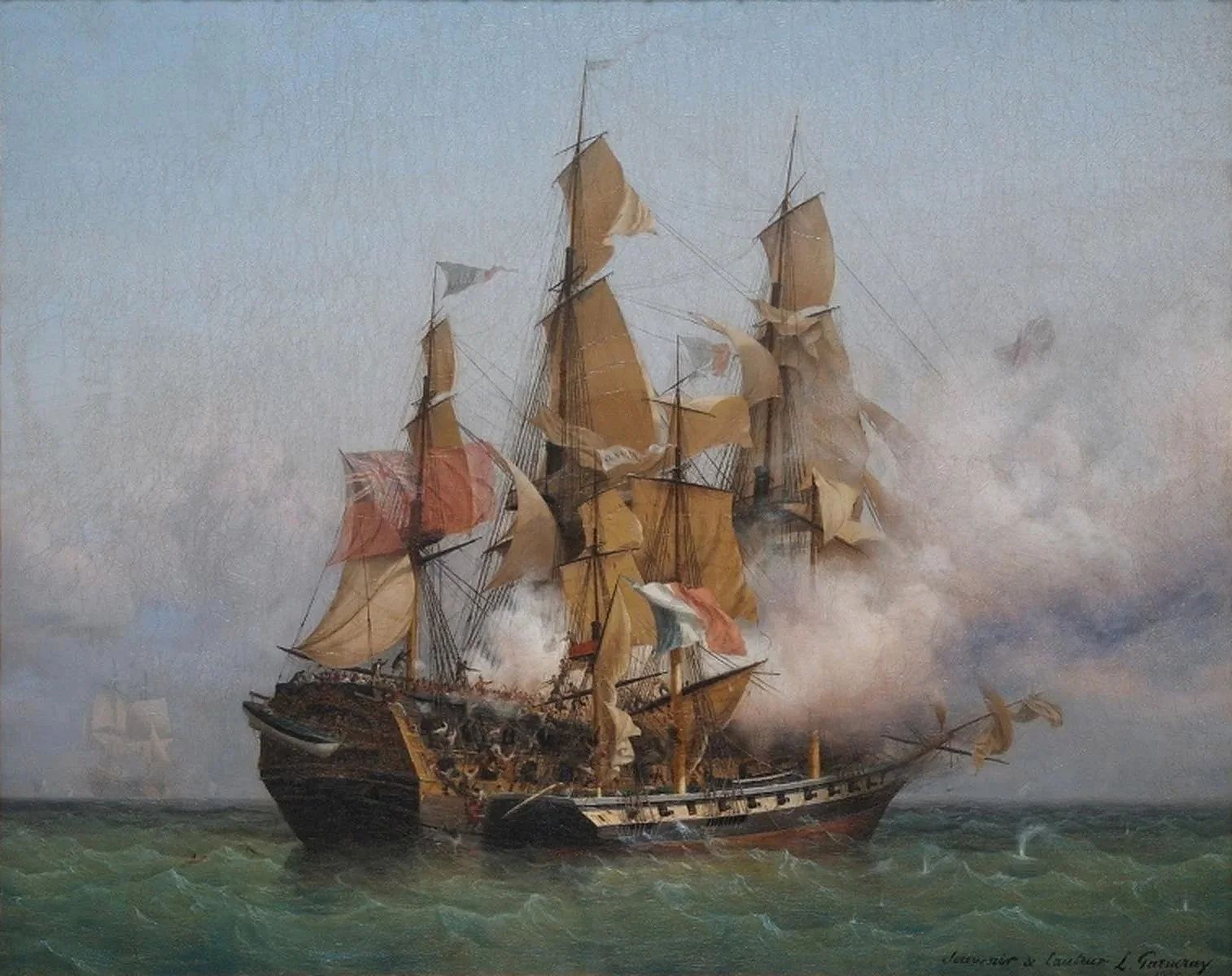
La Confiance under the command of Surcouf captures the Kent. Painting by Ambroise-Louis Garneray.
There is a famous, though possibly apocryphal, exchange attributed to Surcouf and a British prisoner after this battle. The British officer, stung by the defeat, reportedly said: “You French fight for money, while we British fight for honor.” Surcouf is said to have replied: “Each of us fights for what he lacks most.” Whether the exchange actually occurred, Malouins have enjoyed repeating it for two hundred years.
Surcouf retired to Saint-Malo enormously wealthy—his house, the Hôtel Surcouf, still stands in the city—and died in 1827. His statue stands in the Jardin du Cavalier, looking out across the ramparts to the sea. A replica of the Renard, the last ship he armed, still operates out of Saint-Malo as a sailing vessel.
The City They Built
The wealth the corsairs generated was not hoarded. It was invested in the city, and the results are visible everywhere in Saint-Malo today.
The corsair captains and their backers built malouinières, magnificent stone mansions, both within the city walls and in the surrounding countryside. They announced their owners’ prosperity to anyone who cared to look. The Hôtel Magon, one of the finest of these surviving townhouses, was built under Louis XIV by François-Auguste Magon de la Lande, a shipowner and privateer who had been director of the French East India Company. It is now open to visitors, and inside you can see an authentic lettre de marque, a corsair’s saber, a captain’s chest, and the cellar where treasures were stored.
The corsair economy funded churches, public buildings, hospitals, and the city's formidable coastal defenses. It also, in a less comfortable chapter of history, funded the slave trade—notoriously in the case of Robert Surcouf, who organized at least six illegal slaving expeditions between 1815 and 1821. This dimension of Saint-Malo’s corsair history is now acknowledged alongside the maritime heroics, and the city’s relationship with that legacy is more honest than it once was.
The Fête des Corsaires
Every June (the 2026 celebration took place on June 13) Saint-Malo commemorates its corsair heritage with the Fête des Corsaires, a day-long festival that has become one of the city’s most popular annual events since it debuted in 2019.
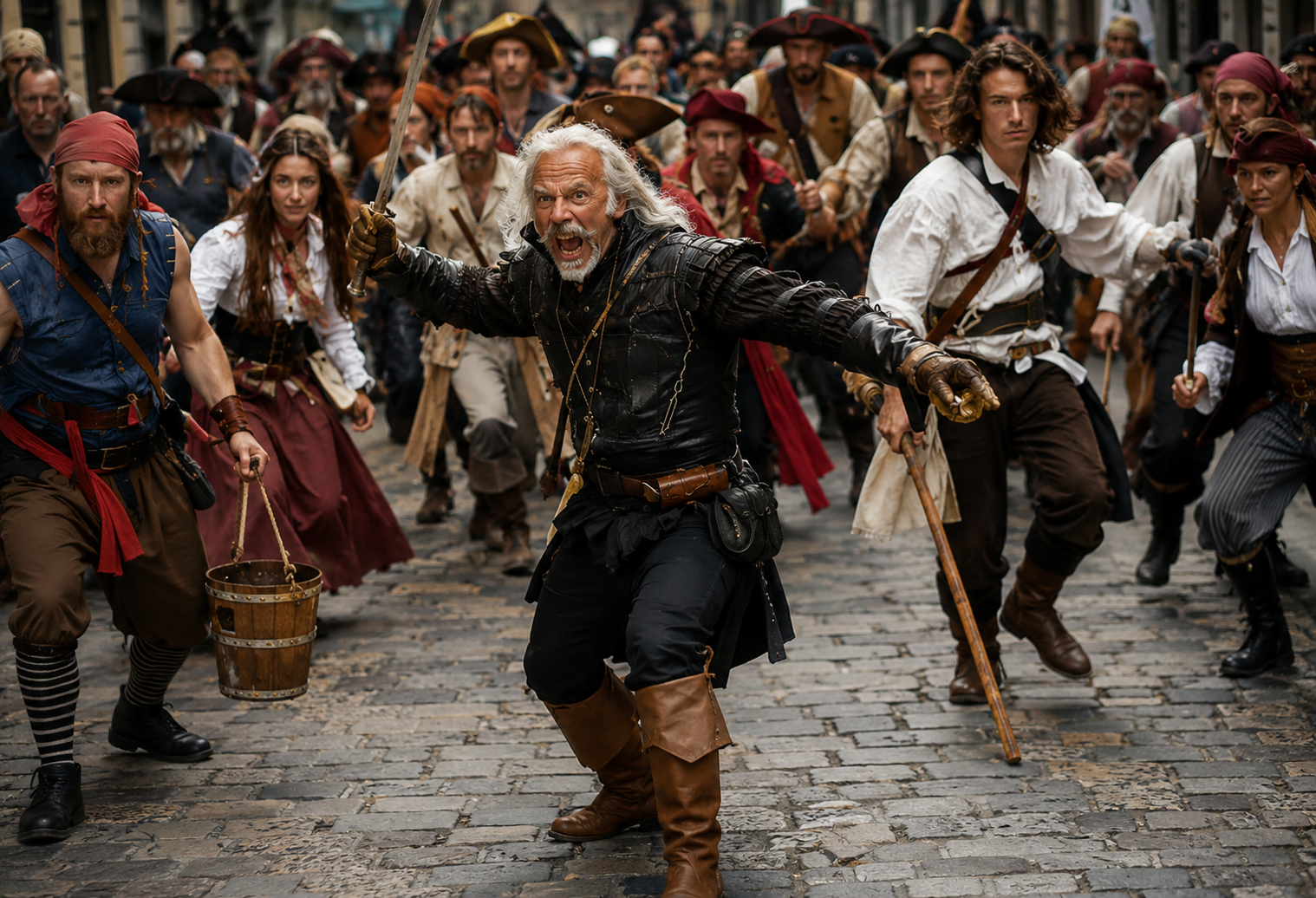
Fête des Corsaires in Saint-Malo
More than 300 volunteers in period costume bring the Corsair City back to the 18th century for a day. The Esplanade Saint-Vincent fills with historical reenactments, fencing duels, simulated naval battles, concerts, and traditional dances. Each year takes a different theme—the 2026 edition was titled "Return from Peru," following the fictional adventures of Captain Malo across the South Sea. The day culminates in a Grand Corsair Parade, when the costumed company marches through the Intra-Muros to cheers, music, and the ringing of Noguette in the cathedral. Visitors who come in costume can earn malos d'or, the symbolic currency of the day, by participating in a city-wide treasure hunt.
It is, in the best sense, history made accessible, and loud, and a little raucous, which is perhaps appropriate for a city that spent three centuries profiting as a maritime disruptor.
A Note for Anyone Arriving by Sea
There is something particular about sailing into Saint-Malo that you can’t fully appreciate until you’ve done it. The city appears ahead of you from the water as a solid granite wall rising straight from the tidal flats—the ramparts, the towers, the cathedral spire—exactly as it appeared to every ship that ever approached its harbor, friendly or otherwise. The tidal range here is among the highest in Europe: at low water, the harbor entrance dries to exposed rock and the city sits high on its island; at high tide, the sea comes nearly to the base of the walls. During occasional grandes marées (spring tides), when the sun and moon align, massive waves crash over the walls!
The corsairs knew the harbor intimately. They used the tides the way QBE crews use them today, timing their departures and arrivals around the water, reading the conditions, understanding that this coast rewards knowledge and punishes ignorance. The difference is that when Duguay-Trouin slipped out of Saint-Malo on a tide in the early hours, he was headed for the English Channel with a letter from the king in his pocket and a crew of fighting men on deck.
We take our crews out of the same harbor, on similar tides, in boats that are the direct descendants of the vessels the corsairs used. We are not, it should be noted, licensed to attack English shipping. In fact, that would be us! (We fly British yacht ensigns!) But the seamanship is the same.
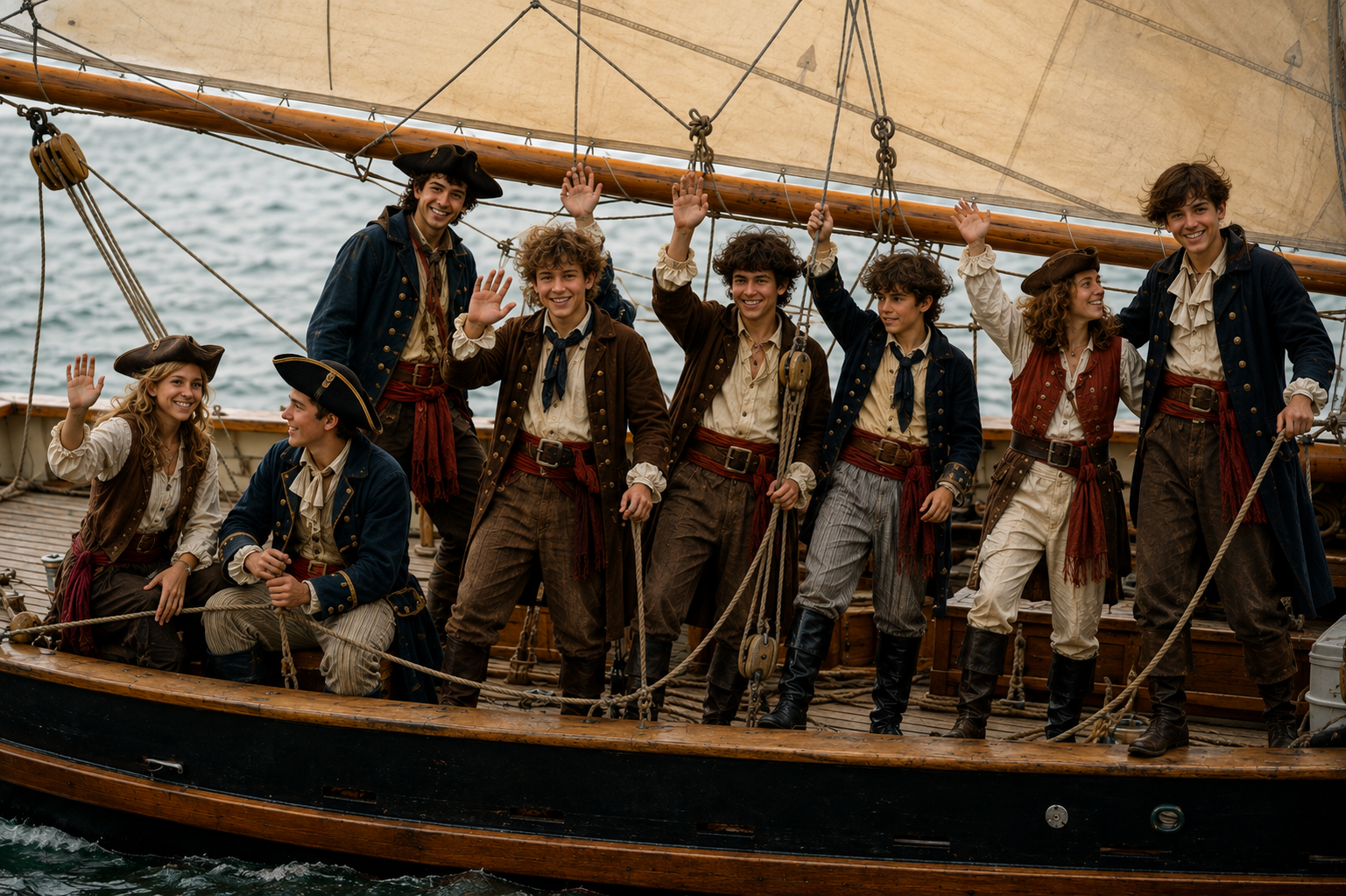
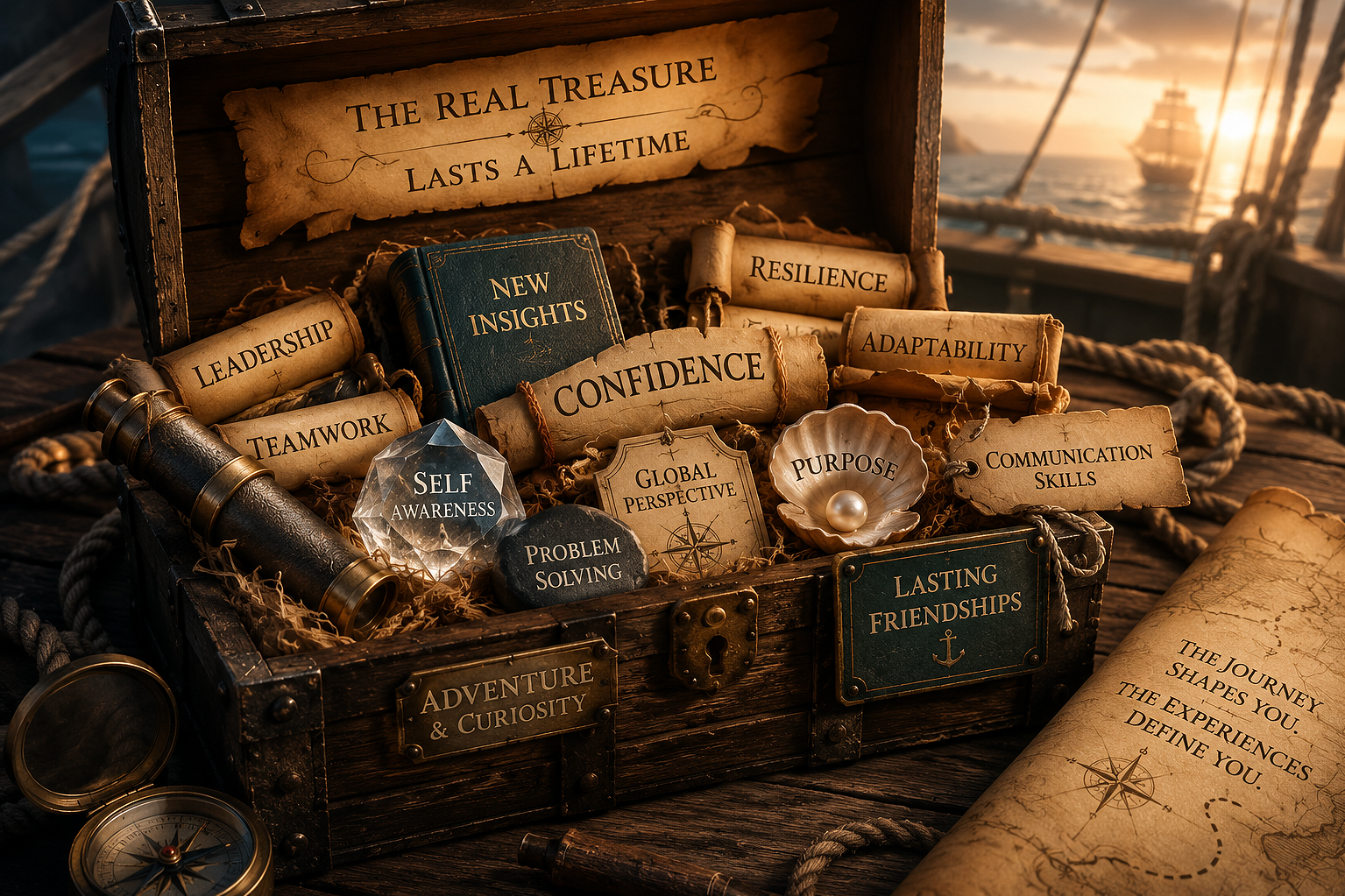
You no doubt have heard of The Pirates of the Caribbean. Well, here are some young Corsairs of the Channel (with some wardrobe help from AI) on a QBE pilot cutter. And below, a look at their booty…
The Hôtel Magon, the Musée d'Histoire de Saint-Malo, and the statues of Duguay-Trouin and Surcouf on the ramparts are all accessible on foot within the Intra-Muros.