
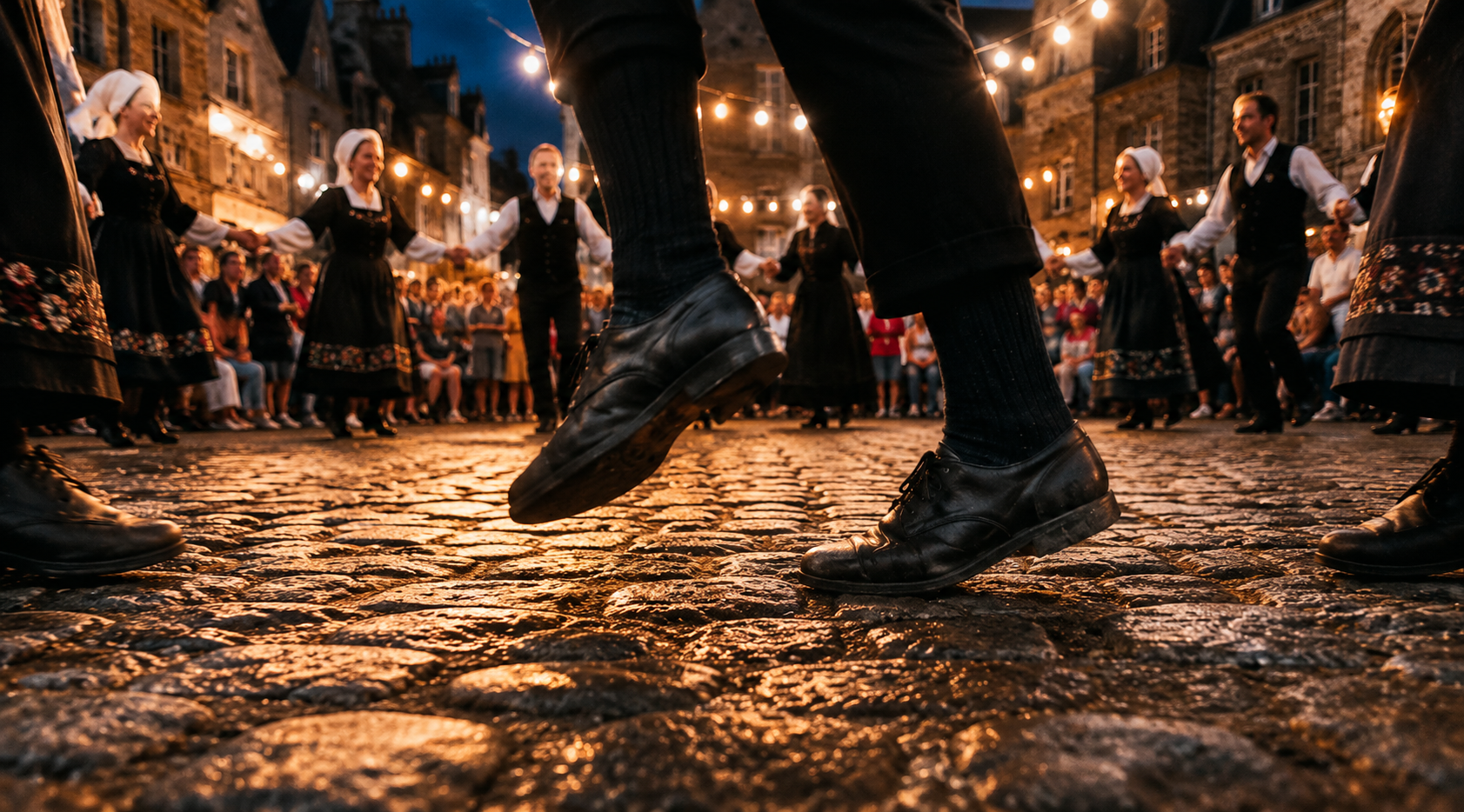
Inscribed on UNESCO’s Intangible Cultural Heritage list since 2012, a fest-noz isn’t something you watch—it’s a celebration you’re welcome to participate in.
There’s something genuinely striking the first time you attend a fest-noz: nobody stays seated. From the first bars of a gavotte or an an-dro, strangers take each other's hands, form chains or circles, and start dancing together—often without anybody knowing who knew whom the night before.
That’s precisely what earned the fest-noz its place, in December 2012, on UNESCO’s Representative List of the Intangible Cultural Heritage of Humanity.
A celebration, not a tradition frozen in time
UNESCO’s definition leaves no room for ambiguity: a fest-noz is “a festive gathering based on the collective practice of traditional Breton dances, accompanied by singing or instrumental music.” Roughly a thousand festoù-noz (the Breton plural) take place across the region every year, drawing crowds that range from a hundred to several thousand people, including thousands of musicians and singers and tens of thousands of regular dancers.
But beyond the numbers, what strikes most observers is the nature of the event itself. As one French Ministry of Culture representative put it at the time of the UNESCO inscription: “The fest-noz is part of Breton heritage. It’s the exact opposite of frozen folklore.” This isn‘t a historical reenactment staged for tourists—it’s an authentic, living tradition, constantly evolving, with hundreds of dance variations and thousands of different tunes depending on which part of Brittany you’re in.
Dances that trace back to the Middle Ages
Vincent Morel, a curator and network coordinator for Haute-Bretagne at Dastum—an association whose mission is to collect and pass on Brittany’s oral heritage—explains that these dances have deep cultural roots: “By the late Middle Ages, people were already dancing in circles or chains, with steps that repeat indefinitely.” The more structured “figure” dances, performed in groups of four or eight, emerged later, in the 19th century, while couple dances rounded out the repertoire over time. Most festoù-noz today rotate through all three dance variations over the course of an evening.
On the musical side, two traditions coexist: a cappella duet singing known as kan ha diskan—one singer leads a phrase, a second answers it, creating a rhythmic call-and-response that carries the dancers along—and instrumental music, historically carried by the biniou kozh (the Breton bagpipe) and the bombarde, two instruments originally chosen for their impressive volume, long before amplifiers existed.
Learning by immersion
What sets festoù-noz apart from many heritage traditions is how they’re passed down—not through formal instruction, but through immersion, observation, and imitation. You learn to dance an an-dro by dancing it, surrounded by more experienced dancers who guide you without a word—a hand that gently squeezes yours to mark the tempo, a glance that invites you to follow the movement.
It’s also, according to UNESCO, a space of remarkable social and intergenerational mixing: teenagers and grandparents share the same circle, seasoned dancers and complete beginners dance side by side. Many newcomers to Breton villages actually use a fest-noz as a way to integrate themselves into the community, so closely is the practice tied to a sense of belonging to the local culture.
A tradition very much alive in 2026
Far from settling into nostalgia, festoù-noz continue to produce new talent and new encounters. The Grand Fest-Noz de Kerjean, for instance, returned in June 2026 in the courtyard of the Château de Kerjean in Finistère, with a lineup of well-known singers and pipers from across Brittany—including, in a sign of the times, duos pairing bombarde with Scottish bagpipes, like the one formed by Maelann Hervé and Enora Morice, two young musicians who met in high school and now perform as far afield as Scotland.
Why it matters for a QBE crew
For our crews, stumbling onto a fest-noz or fest-deiz during a port stop is never a small thing. It’s a chance to experience, very concretely, what it means for a culture to be passed down through practice rather than instruction: nobody explains the steps before you dance—you learn by letting the circle carry you along. It’s also one of the rare moments where teenagers from several different countries find themselves, with no preparation, taking part together in something authentically Breton—hand in hand with strangers, to the sound of a bombarde, late into the night.
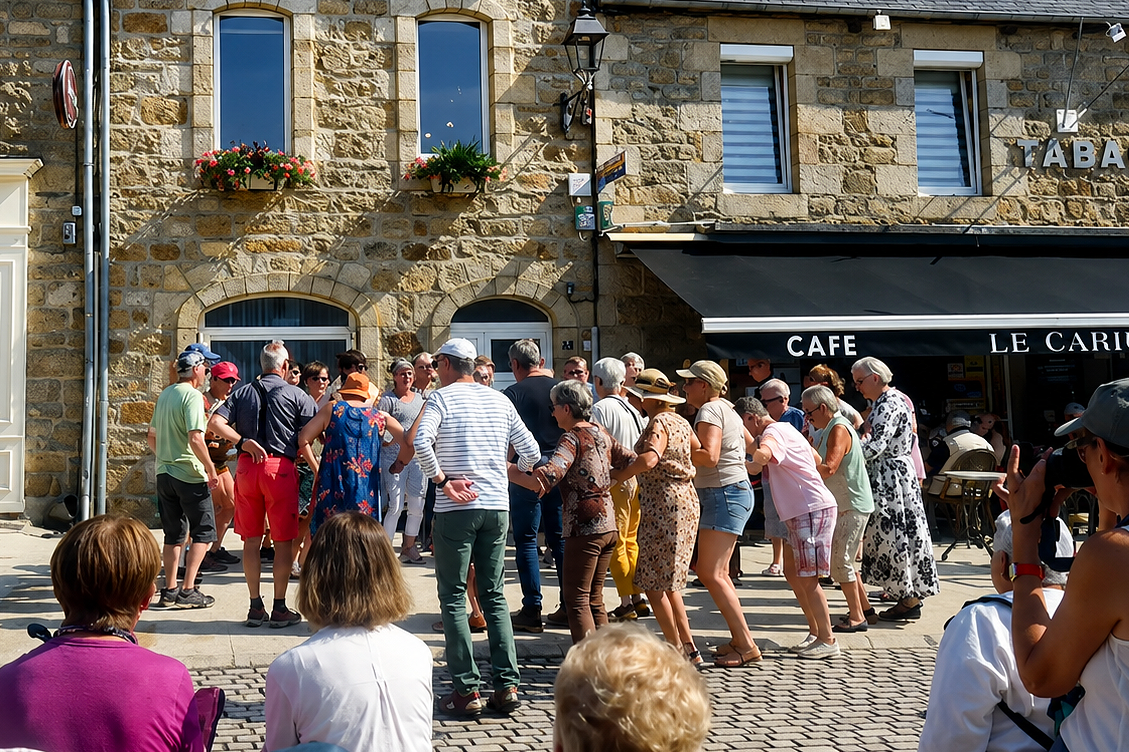
Here’s a little fest-deiz (a daytime celebration) we happened upon during our June 2026 expedition.
---
The fest-noz has been on UNESCO's Representative List of the Intangible Cultural Heritage of Humanity since 2012. Roughly a thousand festoù-noz take place across Brittany every year.