
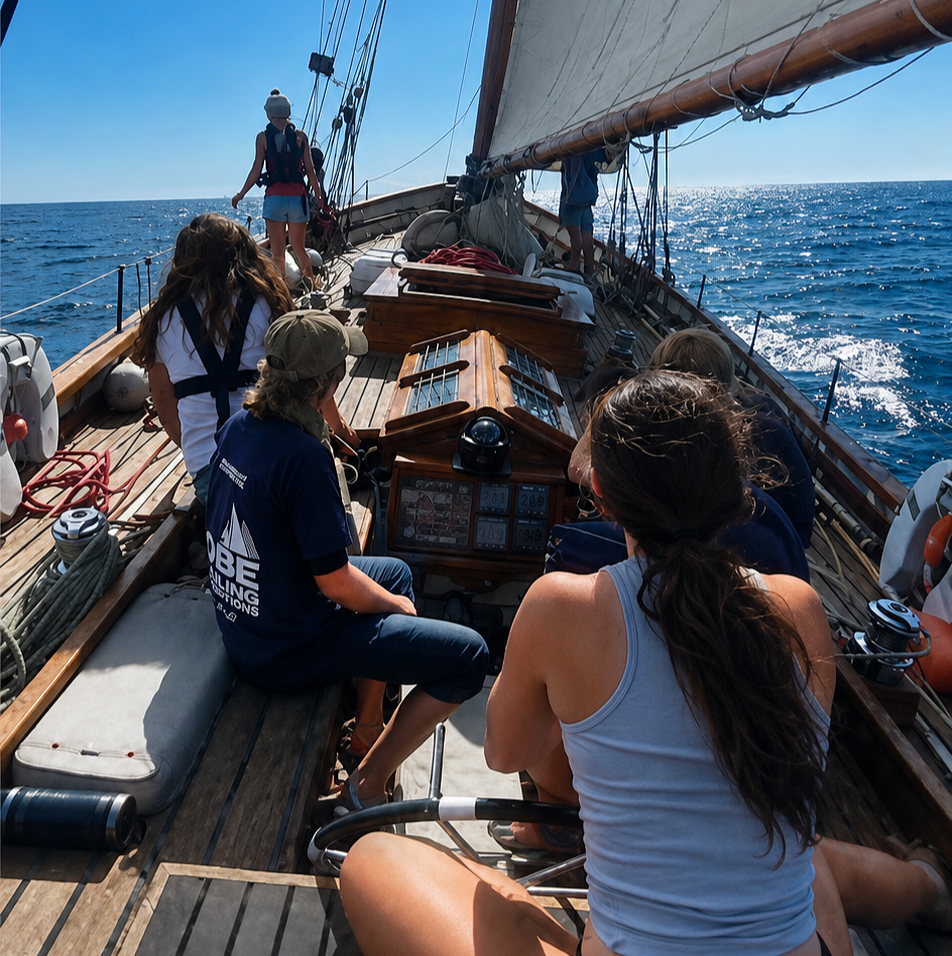
Walk down almost any marina in summer and you’ll see impressive yachts with gleaming teak decks, polished stainless steel, and crews bustling about preparing for the day's sail.
Now imagine putting twelve teenagers aboard one of them.
The experience probably would be enjoyable. It almost certainly would be memorable. But would it constitute a leadership course? Not necessarily. Because leadership isn’t created by some frisson while out yachting. It’s created by responsibility and a resulting sense of achievement. Responsibility is difficult to avoid when there are only six or seven people aboard. Rising to that responsibility brings that uplifting sense of achievement.
The Mathematics of Responsibility
Leadership experts often speak about accountability as though it were a matter of culture.
It turns out, it’s also a matter of arithmetic.
Imagine a crew of thirty. If one person doesn’t pull his or her weight, twenty-nine others can compensate. The voyage continues. Meals get cooked. The sails still go up and come down. It’s easy for an individual to disappear into the crowd.
Now imagine a crew of six. When one person neglects a task everyone notices. Not because anyone is looking to assign blame, but because every individual genuinely matters. There’s an element of indispensability. Small crews don’t merely encourage participation. They require it.
There’s No Audience
Many educational experiences unintentionally create spectators. One student takes charge. Another hangs back. A third quietly lets others solve a problem.
Life aboard a small sailing vessel doesn’t offer that luxury.
Every sail must be hoisted. Every meal prepared. Every line coiled.
Everyone cooks. Everyone cleans. And everyone learns.
Responsibility isn’t assigned once. It circulates continuously.
Over time you notice something subtle happening: Teenagers stop asking,"What do I have to do?" and begin asking,"What needs doing now?" “How can I help?”
That’s one of the most pivotal shifts in leadership development.
The Ocean Doesn’t Care About Titles
Schools have prefects or class officers. Sports teams have captains. Organizations have presidents.
The sea doesn’t recognize credentials. A sixteen-year old helming a traditional sailing vessel into a small French harbor understands that confidence has precious little to do with some certification.
The boat responds only to judgment earned mostly through experience. It’s skill at setting sails that makes a boat respond to the wind. Leadership becomes something acquired minute by minute as experience accumulates and confidence grows—a leadership funnel.
And because nature provides immediate, honest feedback, young people learn a lesson that’s simply difficult to teach in classrooms:
It’s acquired competence that creates confidence. Not the other way around.
Small Crews Create Real Consequences
Psychologists often distinguish between artificial challenges and authentic ones. Teenagers know the difference instinctively.
A classroom simulation may feel like a game. A real voyage doesn’t.
If supper isn’t prepared, people don’t eat. If a sail isn’t raised, the boat doesn’t move. If someone forgets his or her responsibility, the entire crew has to adjust.
These aren’t manufactured “teachable moments.” They’re just the way it is. Ironically, this makes them extraordinarily teachable.
Leadership Begins with Service
Popular culture often portrays leadership as standing in front of people saying, “Everybody, follow me!”
Real leadership often looks very different.
It's making tea for a tired crewmate. Taking a midnight watch. Cleaning the galley without being asked. Helping someone reef a sail in the rain.
The best leaders aboard small boats are rarely the loudest.
They're often the first to notice what needs doing and quietly do it.
Young people internalize this almost unconsciously.
They begin to understand that leadership is as much about being dependable, about seeing and doing things that need to be done as it is about being “in charge.” It’s a consistent manifestation of character.
Confidence Grows in Small Circles
Parents everywhere hope their children will grow up to become confident teenagers and adults.
Their instinct often is to put them on ever larger stages: Bigger and better schools. More competitive teams. More ambitious adventures.
Yet confidence frequently grows in unexpected places.
It develops inside small communities where every voice matters and every contribution is visible.
A shy teenager can’t hide for long among a group of six crew members. Sooner or later everyone has the helm. Everyone makes decisions. Everyone has “a moment.” Inevitably, all our young QBE crew members discover they’re capable of much more than they initially imagined.
That resulting confidence, it turns out, is remarkably difficult to outsource.